ABSW Awards 2026 highlight the challenges facing the scientific community today
"The writers whom I have looked up to for years are some of the most encouraging people out there." By Anoushka Sinha, ABSW Student Rep.
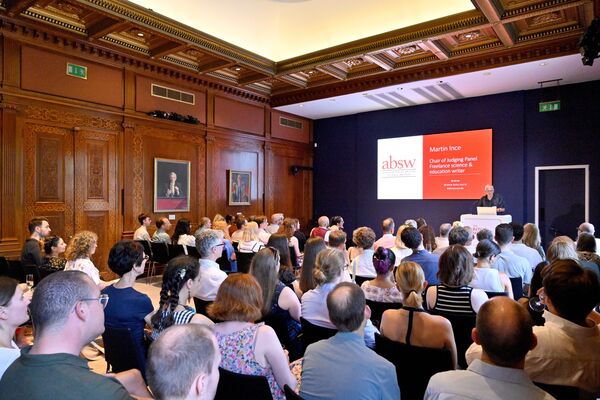
On 24 June 2026, science writers from all over the UK and Ireland braved the heatwave to attend the Association of British Science Writers Awards 2026 at the Royal Society in London.
Upon arriving, I was met with a much-needed refreshment and got to chatting with this year’s finalists in the Marble Hall.
At this much-anticipated event, surrounded by science communicators, some of whose work I had followed for many years, there was only one question everyone was asking – “Shall we move closer to the air-con?”
Jokes aside, the networking session, like most ABSW events, involved wholesome and down-to-earth interactions with truly brilliant minds.
As the ABSW Student Representative, I often find that I am the youngest person in the room. This was daunting until I realised that the writers whom I have looked up to for years are some of the most encouraging people out there. I was met with inspiring life stories and advice.
Attendees were soon led into the Kohn Centre for the awards ceremony, and the ceremony started with a welcome from ABSW Vice-Chair, Sarah Wild. She discussed the challenges facing scientists and science journalists in a time of rampant disinformation and geopolitical turmoil.
Wild also pointed out that, aside from information, science journalists fulfil another need of the public: science journalists provide “wonder and delight”. Science is a world of “awe and, well, magic” which provides not only information but also hope for the public, she said.
The awards were presented by ABSW Honorary President Roger Highfield.
Martin Ince, former Chair of the ABSW and Chair of the ABSW Awards judging panel, received this year’s ABSW Lifetime Achievement Award. He is celebrated for having rescued the ABSW from financial ruin and co-founding the World University Rankings, among other achievements.
ABSW Board Member Aisling Irwin introduced the award, saying, “We don’t always hand out a lifetime achievement award. We award it when we feel there is someone we want to reward for their outstanding contributions in leadership or services to science journalism or science writing.”
I was surprised to find out that, during the 2008 financial crisis, Ince saved the ABSW from “impending financial ruin”. The attendees listened in awe as Irwin explained that “rather than going gentle into that good night, Ted [Nield – former ABSW Chair] and Martin [Ince] did rage against the dying night”.
By hosting the World Conference of Science Journalists, they were able to revive the ABSW and ensure it not only lives but thrives all these years later. As we prepare to host the World Conference of Science Journalists next year, the warmth of this full-circle moment enveloped the room.
Irwin also pointed out that in order to be “an award-winning science writer, you also need to be a nerd – and not just a nerd but an enchanting nerd”. “Here Martin has excelled,” she said. His mind is “a huge filing cabinet full of knowledge”.
When asked his thoughts on the awards and their place in the world of science, Ince said, “We have almost 800 members, who between you submitted almost 300 entries…. That is a terrific ratio which shows how highly these awards are valued by this community.”
As a young person, it can be easy to look to the future with dismay, but Ince pointed out that even in this “era of misinformation”, science writers “are not succumbing to the deadliest of writing diseases” such as AI.
This was Ince’s last year as Chair of the ABSW Awards. Some might have gotten nostalgic; Ince instead had the room in giggles, joking about how news has changed in his time. “While I will always know what a good story tastes like, I am getting steadily less aware of how news is created, consumed and passed on,” he said.
Leo Enright, Irish broadcaster and space communicator, will take over at the helm of the judging panel from next year.
After the awards, we all filtered out into the Marble Hall for canapes and networking. As people mingled, what stood out was how many relationships had been built through ABSW events.
The first ABSW event I attended was the 2024 Awards, where I found that science journalists from all over the UK knew and recognised each other from awards of years past. Two years on, I was one of those people, recognising journalists I had met at ABSW events over the years.
The warm sense of community among science communicators was prevalent throughout the evening.
The ABSW would like to thank the sponsors who made this event possible: The Association of the British Pharmaceutical Industry, The Royal Society, the Dr Katharine Giles Fund, and media partner AlphaGalileo.
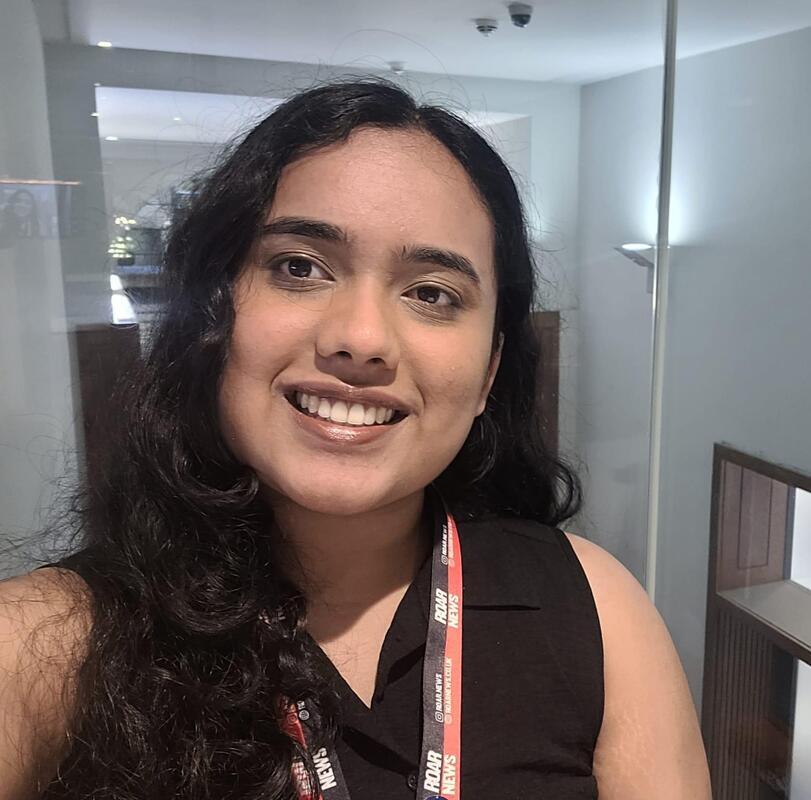
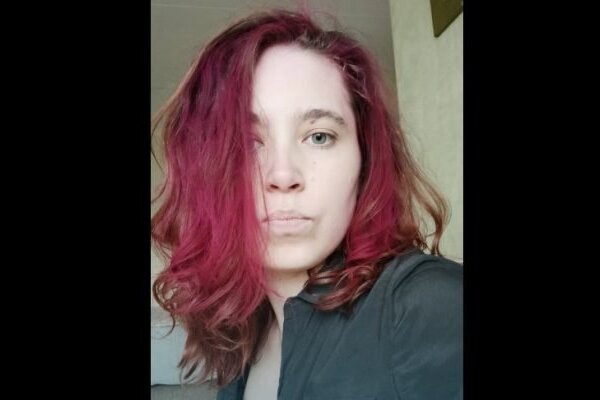
Anoushka Sinha is currently the ABSW Student Rep.
Anoushka is in her third year at King’s College London (KCL), studying for an MSci in Physics with Astrophysics and Cosmology. She is Head of Science at her university newspaper, Roar, and also works as an Astronomy Presenter at the Royal Observatory Greenwich.
She completed a research fellowship at KCL, simulating particles using analogue computers and thereby making quantum research more accessible and efficient.