"We feel we are not allowed to complain": the mental health costs of climate reporting
Mental health and barriers to climate and science journalists in the spotlight at recent journalism conferences.

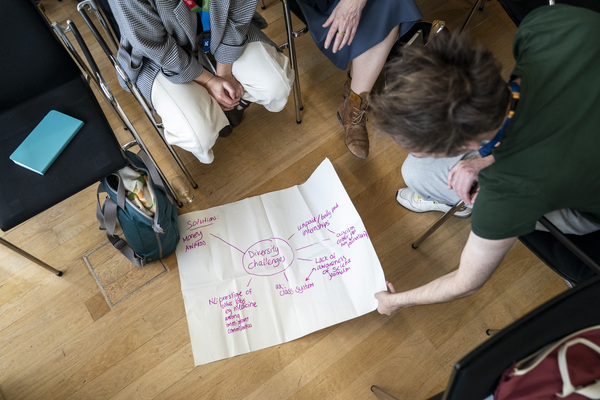
Participants at the ECSJ2026 session discussed in groups challenges and solutions to entering the science journalism industry. Photo credit: Burkert/Pilar
“We often share that feeling of shame and guilt, we feel we are not allowed to complain or to ask for help, because there is always someone else suffering more, or there are bigger causes that need more attention,” said Irene Baños, a multimedia journalist from Spain, who focuses on environmental and climate reporting.
Journalists are often romanticised as dedicated professionals, without boundaries between their personal and professional lives, journalist Irene Baños told the session Reporting on the Planet and Paying the Price, at the online Mental Health in Journalism Summit (MHJS2026) in October.
Yet research presented at the session suggests that journalists covering science and climate are paying a significant psychological price. A UK survey conducted by ABSW and the University of the West of England (UWE Bristol) found that more than a third of respondents had experienced online harassment related to their work, while a US study revealed high levels of anxiety and depression among climate journalists.
As a result, some journalists avoid reporting on certain topics due to workplace and online harassment, potential legal challenges, or threats to their safety. Together with financial barriers, these fears can determine who gets to work in science journalism, which stories are told, and whose perspectives reach the public. This issue was at the heart of 'Changing the Story: Making Science Journalism More Equitable and Supportive', a session held at the European Conference of Science Journalism (ECSJ2026) in Hanover, Germany, that same month.
The ABSW/UWE survey, conducted in 2025, gathered responses from 75 participants whose work was mainly published or broadcast in the UK, explained Andy Ridgway, associate professor at UWE Bristol and ABSW board member, in both conferences. Among respondents, 51% reported having experienced workplace harassment, while 35% had experienced online abuse related to their work. Topics that triggered harassment included climate change, vaccines, and COVID-19.
The US research surveyed 188 climate journalists during 2024 and 2025. This study, conducted by Rebecca Watson of the Climate Psychology Alliance of North America, and climate journalist Yesenia Funes, focused specifically on mental health and emotional experiences.
The findings were striking: 77% of respondents recorded moderate to extremely severe anxiety, 41% scored in the severe to extremely severe range for depression, and 54% reported moderate to severe stress.
Psychological violence was the most commonly reported form of abuse among journalists in a seven-country European study in 2026. Maria Zuffova, a research fellow at the European University Institute, presented these findings, in a video, at ECSJ2026.
“We can all agree that media criticism is important, it is legitimate as it helps maintain professional standards. But what we found in the survey results – personalised intimidation, threats of physical violence, attempts to discredit journalists' reputation and journalism as an institution – is not the case of media criticism,” Zuffova said.
The support (or the lack of) mentioned by respondents depended on context. In the UK survey, many who had experienced workplace harassment reported receiving no support; most participants had never received training to deal with online abuse.
The US study revealed a different challenge: “We were again surprised to find out that the vast majority [of climate journalists] said that they did have access to mental health coverage, which is obviously good news,” said Watson. However, access to support did not necessarily mean that journalists used it. More than half rarely attended therapy.
For Watson, this raises questions not only about the availability and quality of mental health services, but also about the professional culture that may discourage journalists from seeking help.
The topics that drive harassment can have consequences that extend beyond individual wellbeing. Almost one-third of respondents to the UK survey said there were topics they would avoid reporting on, including those related to race, gender, and politics. This raises concerns about how harassment may influence editorial choices and, ultimately, the information available to audiences.
Watson also pointed to unequal exposure to harassment. Her research found that journalists of colour and trans and non-binary journalists were more likely than white journalists to experience threats of legal action or harassment related to their reporting.
Baños suggested that resistance to climate reporting may partly arise because scientific evidence challenges established behaviours and lifestyles. Reporting on reducing meat consumption or car use, for example, can be perceived as a personal attack rather than information about environmental impacts.
The attacks and accusations also come from colleagues in journalists' own newsrooms, explained Alice Fleerackers, an assistant professor at the University of Amsterdam. At ECSJ2026, she presented the results of interviews with journalists in the Netherlands and Suriname. A recurring finding was that climate journalists risk being labelled as activists simply for reporting on environmental issues, regardless of their reporting approach, even by their colleagues.
The discussion suggested several ways to improve journalists' wellbeing and professional resilience. These included training to manage harassment and emotionally demanding reporting, stronger peer-support networks, more supportive newsroom cultures, better connections between academic research and journalism practice, and strengthening connections with communities.
Watson argued that solutions journalism, which focuses on responses to problems, can benefit journalists' mental health while helping audiences engage more constructively with difficult subjects.
During the ECSJ2026 session, Jana Laura Egelhofer, a researcher at Ludwig Maximilian University of Munich, proposed (in a video) solutions based on her research, including raising awareness of the prevalence and consequences of online abuse and empowering people to engage online in support of victims.
At MHJS2026, Baños closed the session with a clear message: “If we want to report on the planet, we need to start protecting our health first.”