Young Science Writer Award 2026: Celebrating the Next Generation
From AI to whale communication and cancer research, meet the young science writers celebrated at the Science Museum.
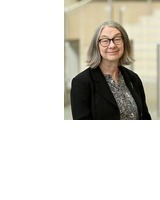
Meet the Author (right): Deborah Cohen - Secretary, Association of British Science Writers (ABSW). Deborah is an award-winning science journalist, editor and an ABSW Board member.
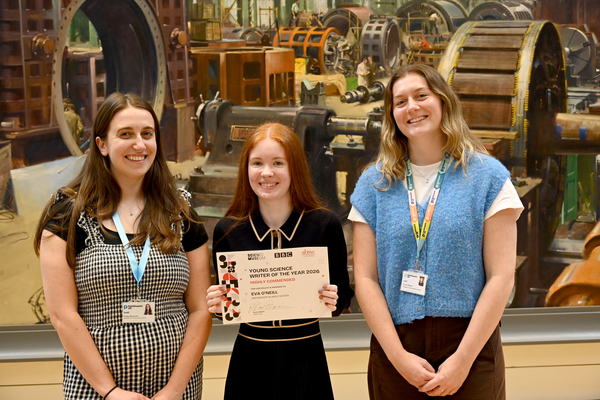
The 5th Young Science Writers Award ceremony was held in the Smith Centre at the Science Museum on 16th September, with Roger Highfield, Director of Science at the Museum and Honorary President of the ABSW as compere. Deborah Cohen, Secretary of the ABSW, was there to meet the winners, their families and teachers as they received their certificates and prizes and heard talks from some leading science journalists and communicators.
YSWA 2026
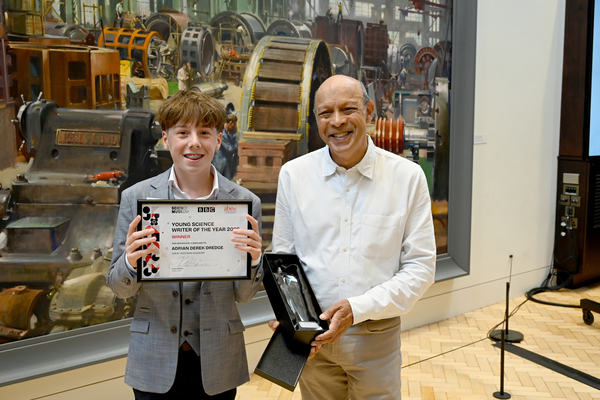
‘I was inspired by watching a film called Mercy’, said the YSWA 2026 winner, Adrian Dredge. The film is about an AI judge deciding if a man was guilty of murdering his wife. Adrian said that he wanted to write about AI and to tell people who think ‘AI is an all-knowing God, that it is not human’. His essay, titled The Digital Explorer, reminded the readers that AI can only use the information that is fed into it, and does not think like a human.
The judges were impressed by the way that Adrian compared AI with a cartographer in a locked room who can only use information from maps that were created 20 years before. The maps drawn by the AI would be useless to us today.
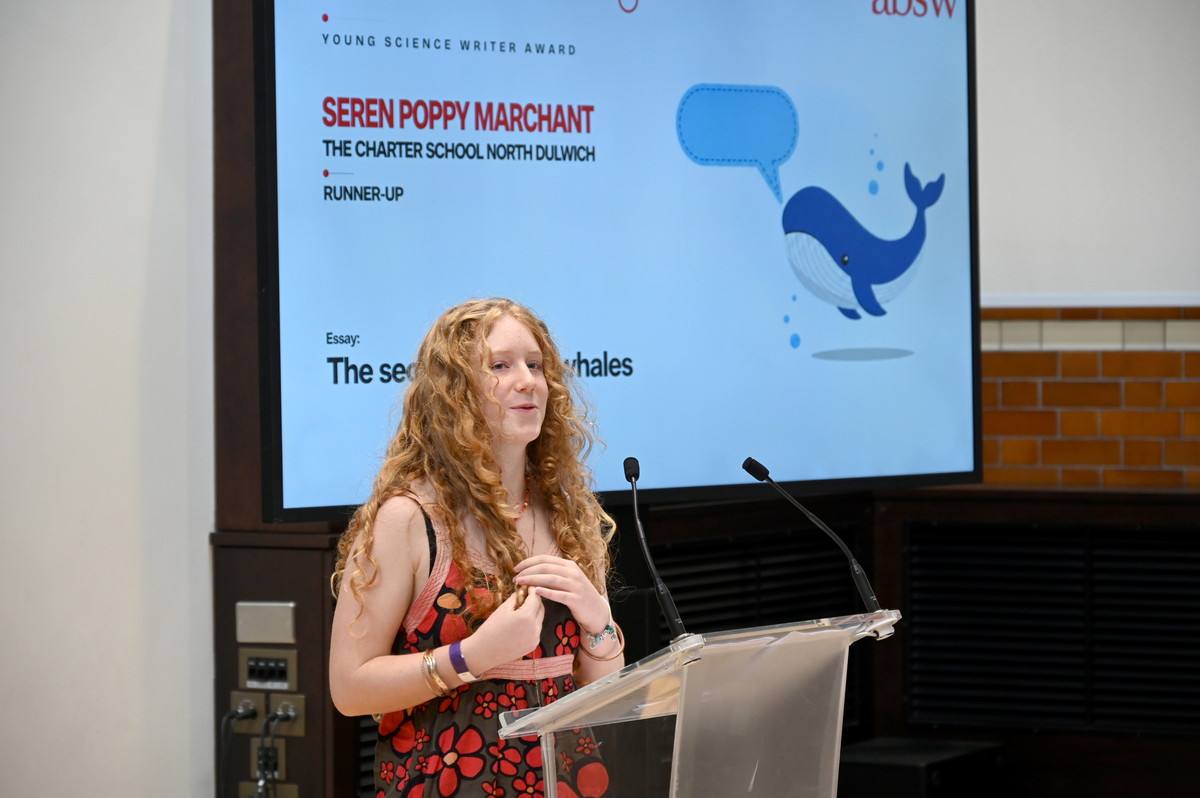
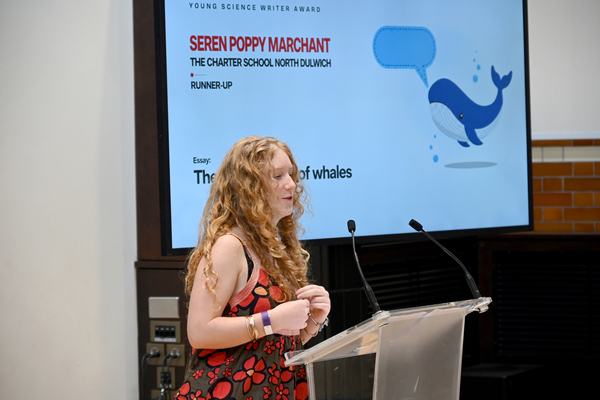
2026 Young Science Writer Award runner-up Poppy Marchant telling the audience what inspired her to write her winning essay about how whales communicate. Photo credit: Mark Lewis Photography.
Poppy Marchant, one of the runners-up, was also inspired by something she saw, in her case an event where a whale communication expert, biologist Tom Mustill, spoke about how humans could talk to whales. Poppy wrote about how a collaboration of marine biologists, linguists, and AI researchers, have analysed the clicks and pauses of sperm whales. Now the scientists believe they have begun to work out the whales’ alphabet.
Poppy said that the most fun part of the project was emailing the experts, including Tom Mustill, and getting positive replies. Poppy would love to be able to talk to these whales and her first question would be ‘can I come for a ride?’.
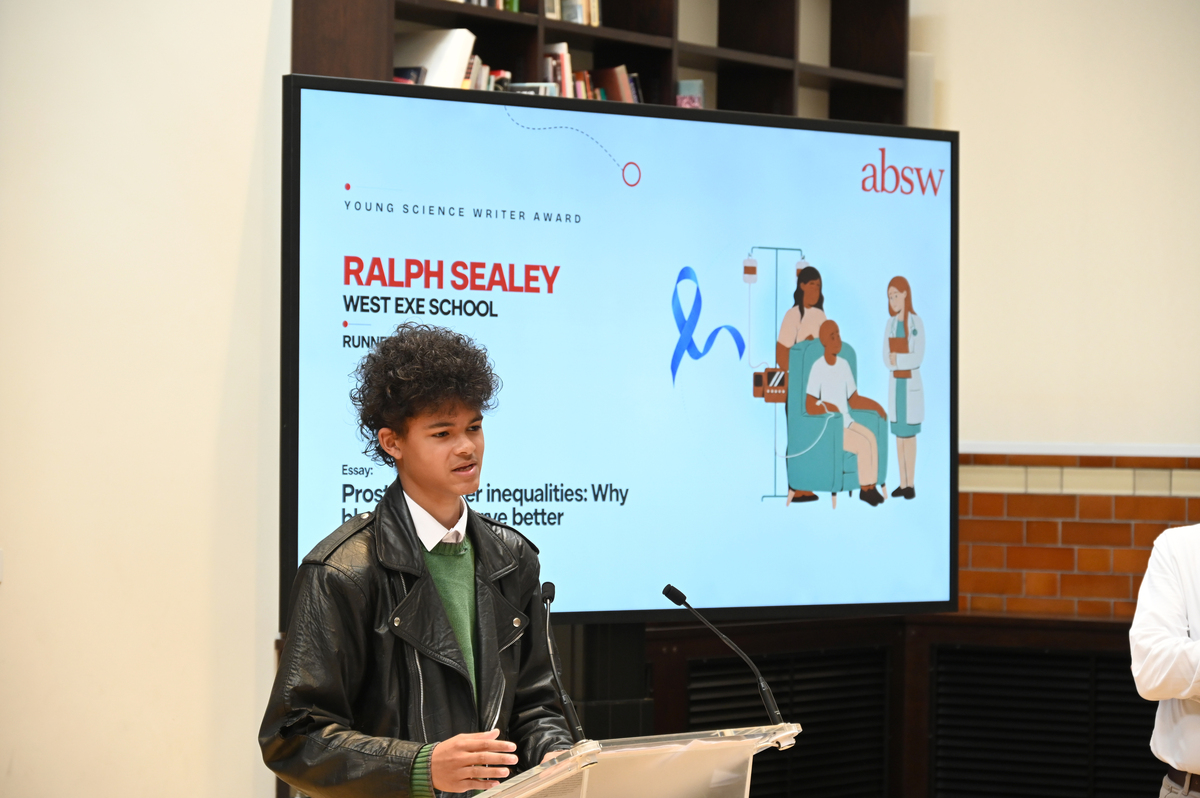
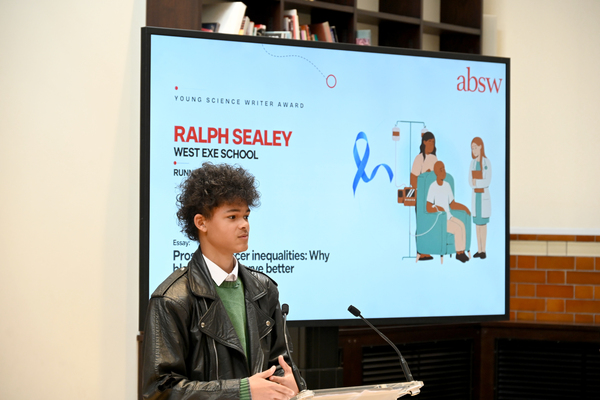
2026 Young Science Writer Award runner-up Ralph Sealey speaking about the personal experiences of his own family which helped to inform how he approached writing his winning essay. Photo credit: Mark Lewis Photography.
Ralph Sealey, the other runner-up, was prompted to write about something close to home, his grandfather’s and father’s diagnoses of prostate cancer. In his essay he talked about ways that black men could be encouraged to go for regular prostate cancer screening as the disease occurs more often in this group. Black men are often reluctant to attend screening so different approaches are needed to reach them, through churches and barber shops, for example. The judges said that Ralph was brave to write about his own experience, and that they were impressed that he wrote about the drawbacks of the standard PSA test and research into a new way of detecting prostate cancer.
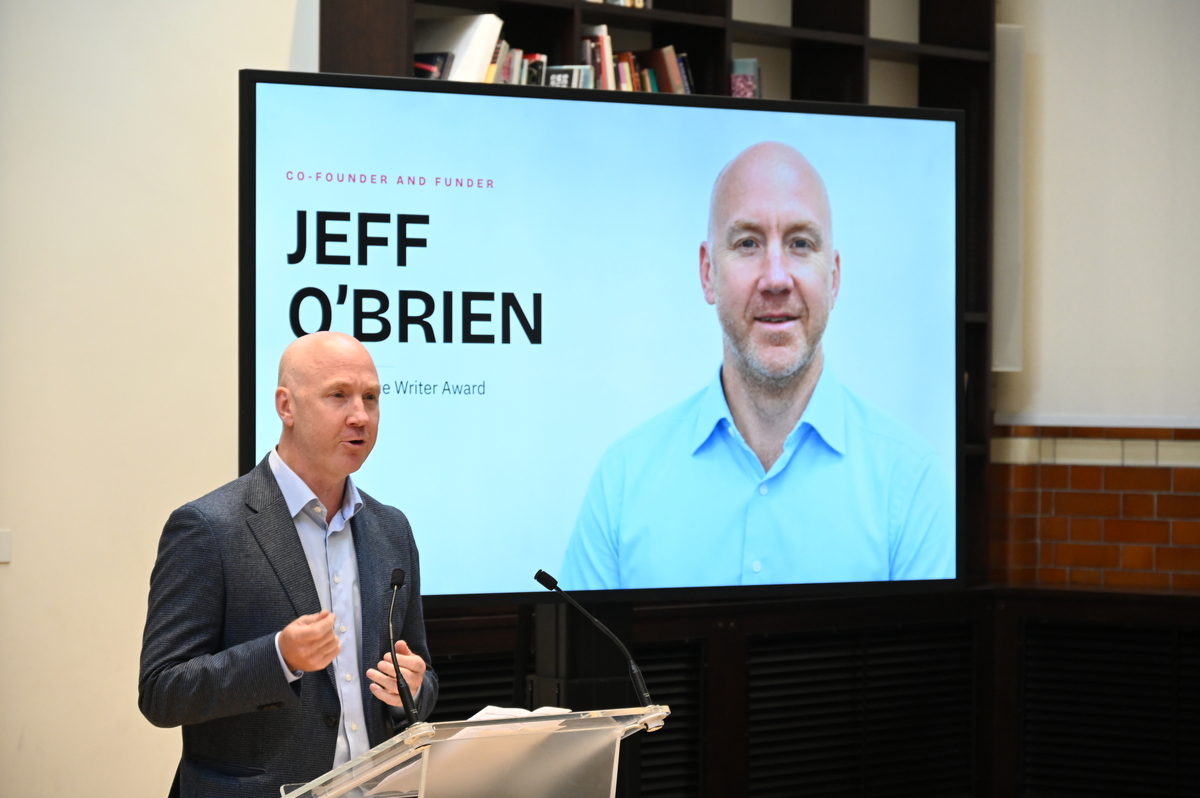
Jeff O'Brien, co-founder and funder of the Young Science Writer Award. Photo Credit: Mark Lewis Photography.
A further ten essays were highly commended by the judges, and covered subjects from health, such as weight loss drugs, the regulation of sugar and the connection between the gut and Parkinson’s disease, to the question of whether life could exist without water, the superpowers of spider silk and the dark side of the moon, from a young Pink Floyd fan.
The winners were selected from more than 1200 essays written by students between the ages of 14 and 16 at non-selective secondary state schools across the UK. The winner won £1000, the runners up received £250 each and £100 went to those who were highly commended. All the winners also received books and stationery.
The prize winners were praised by the professional science journalists and communicators who spoke at the awards. Pallab Ghosh, BBC science correspondent, said that the essays were ‘absolutely fantastic’ and that he hoped being a winner would give the students ‘the confidence to keep on writing about science’. Jeff O’Brien, whose family sponsors the YSWA, said that the awards exist to accelerate the journey of the next generation of science writers and give the winners the opportunity to get started on the career ladder.
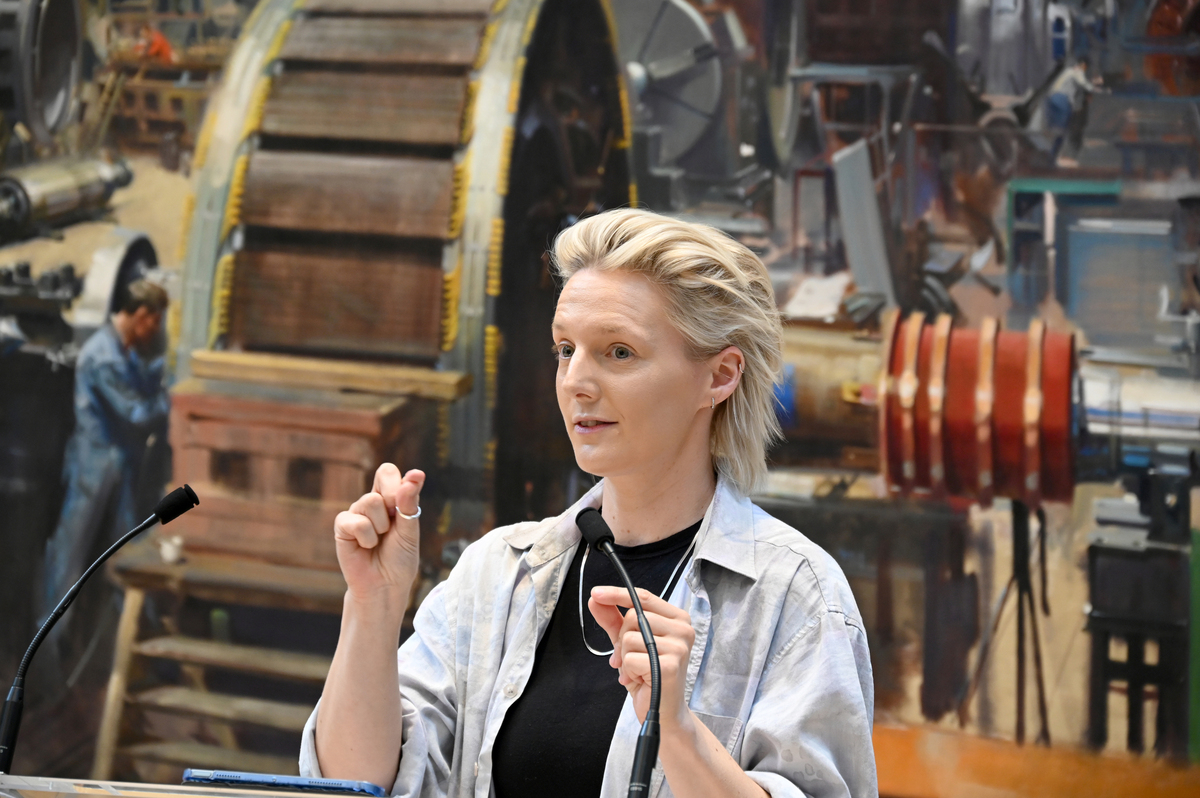
Young Science Writer Award speaker Anna Plojzajski. Photo Credit: Mark Lewis Photography.
Science communicator Khalil Thirlaway welcomed all the winners to the science communication club. He told them that science was much broader than a bunch of facts and introduced the students to the Six Faces of Science that were coined by the physicist Freeman Dyson. Three faces are beautiful: science as the subversion of authority, science as an art form, and science as an international community. The other three are dark and the opposites. Khalil said that it is up to us to decide which of these we should adopt when we communicate about science.
Materials scientist and author of Hand Made, Anna Ploszajski, talked about why science needs great story telling. She said that stories help us make sense of scientific discoveries. If stories are well told we get emotional engagement with the people who are doing research. Anna ended with the call that ‘if you want to change the world, become a scientist, and if you want to change the world a lot become a science writer’.