2026 Young Science Writer Award: Poppy Marchant explores how AI could help us talk to whales
Read Poppy's runner-up essay exploring how AI is helping scientists decode sperm whale clicks, and whether we could one day talk to them.
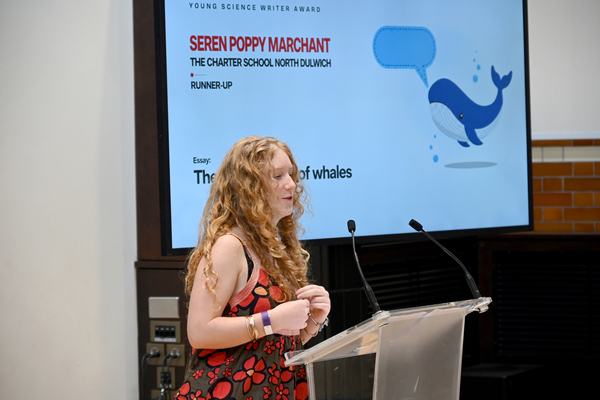
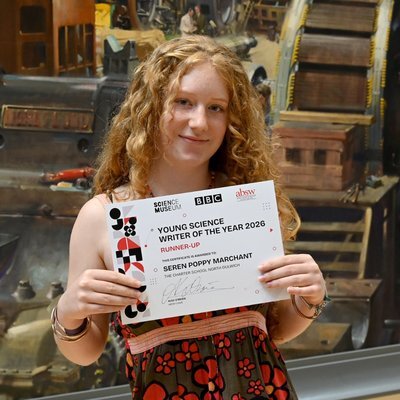
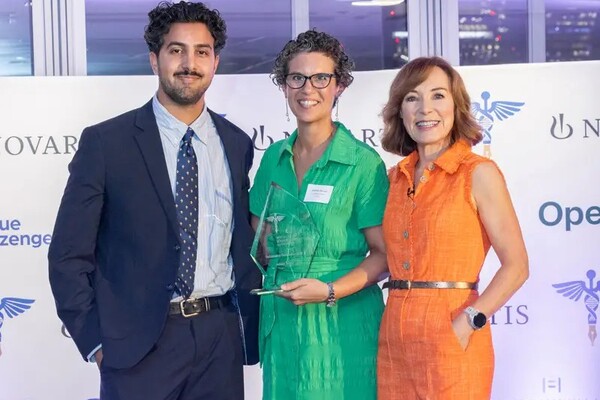
Poppy Marchant, is a pupil at The Charter School North Dulwich in Southwark. Her essay placed runner-up in the Young Science Writer Award 2026 competition. She celebrated her achievement at the awards ceremony at London’s Science Museum on the 16th of September.
The world of science and understanding is forever expanding, but the introduction of artificial intelligence may have jumpstarted a whole new era of communication. In a crossover of marine biology, AI and language, we can finally ask the question: Could we talk to animals?
Whales have been known as some of the most vocal creatures of our planet for decades, with their haunting, melancholic melodies, but their complex patterns of clicks and squeaks are not as well recognised. While for now the songs have tunes we can only dream of interpreting, the clicks created by sperm whales are taking the spotlight.
While previously AI large language models have been used for understanding human languages, some scientists have now used these pattern-recognising systems to study the possible meaning within whale communications. Thanks to this new use of AI, research into the structure of sperm whale sounds has leapt forwards.
In 2024, researchers discovered that sperm whales have an alphabet formed from sequences of clicks, which have different characteristics like tempo and rhythm1.
Through research led by Project CETI, a non-profit collaboration of marine biologists, linguists, AI researchers, and roboticists, the first few letters of this alphabet have finally emerged2.
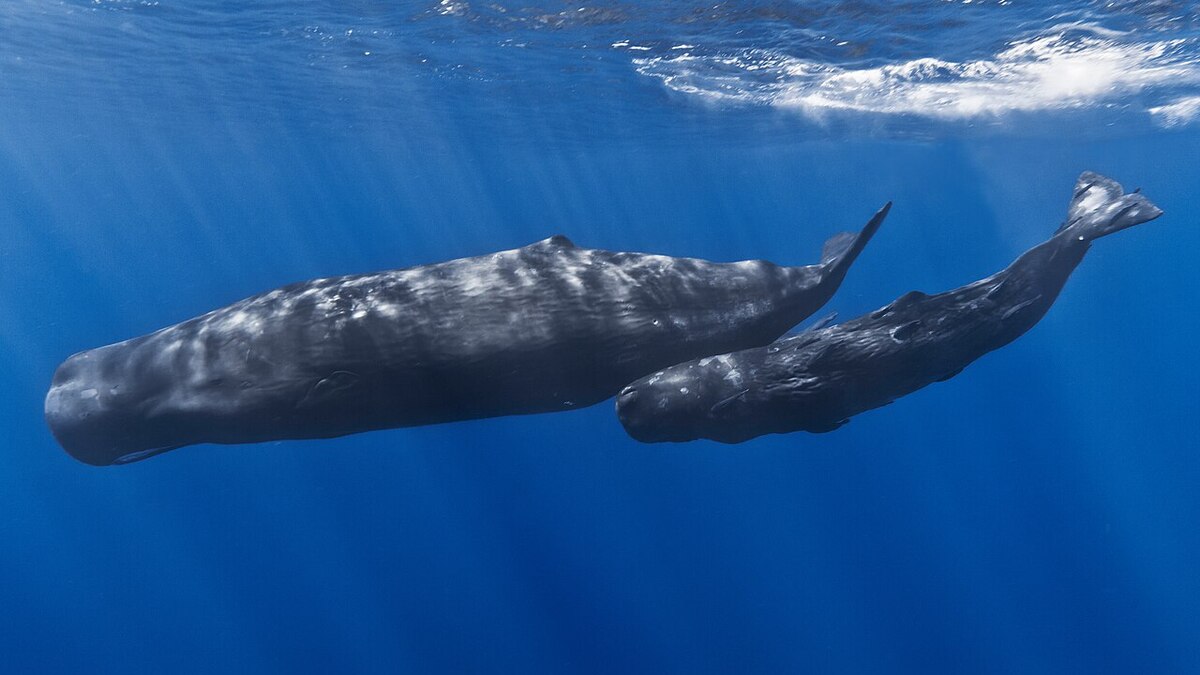
Photo caption: A mother sperm whale and her calf off Mauritius. Photo: Gabriel Barathieu / Wikimedia Commons, CC BY-SA 2.0.
For decades, biologist Shane Gero and his team worked in Dominica observing 30 families of sperm whales and recording their intriguing patterns of clicks and pauses (named codas). These recordings were then analysed using machine-learning models to look for patterns in the different repeating codas. Scientists have since analysed 8,719 recorded codas, and sperm whale families also have different dialects (similar to the difference between the American and English accents).
Distinguishing these repeating phrases provided a challenge, however, and cracking it needed an unlikely helper: elephants. Finding patterns in the recordings was difficult as the codas were extremely slow with long pauses in between. Linguist Gašper Beguš was inspired by a talk from two elephant researchers who mentioned the slower time scale of elephant conversations. This got Beguš thinking: if elephants wait minutes to respond after hearing their name, is it really a reach to suggest that whales – as the world’s largest animals – may also have a slower communication time scale than humans?
By removing these spaces in the recordings and speeding up the codas to a speed more comprehensible to humans, even more patterns and similarities arose from the confusion. While at first the team believed the codas to form a Morse-code-style language with one click equalling one piece of information, condensing these conversations led Gero and Beguš to find that two of the specific codas resembled human language more phonetically, sounding extremely similar to the vowels of a and i. They also believe that with more research several other vowels could be discovered3.
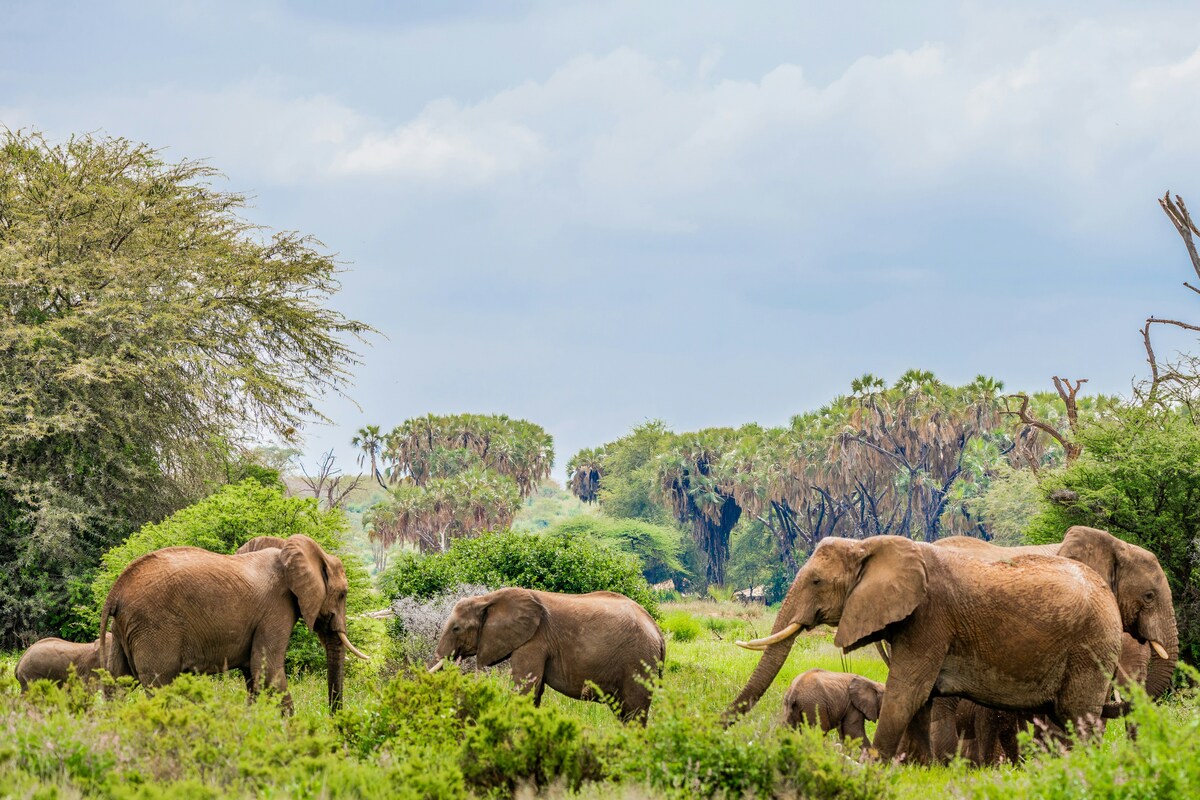
Photo caption: A family of elephants in Samburu National Reserve, Kenya. Photo: Photos By Beks / Unsplash.
But how can an organism so different to us have such a similar language? Turns out the similarities are far from over.
In the whales’ heads are large phonic lips and an air sac which can be used to precisely manipulate sound in a very similar way to a human changing the shape of their mouth to form an a or i vowel.
In another study, a Project CETI team including Gero found that, through studying data from sensor tags attached to the whales, it was possible to predict the behaviour of the whale families. They used the sequence of codas emitted to predict actions like diving with an accuracy of 86%4.
Biologist Tom Mustill, author of How to Speak Whale, says he is “intrigued but not surprised” by the findings, and that
…“the frontier of finding things that other animals do that we hadn’t noticed shift with every time we pay attention”.
The impact of this astounding new perspective of whales is already sparking one of the most widespread conservation efforts ever to protect these magnificent creatures. But what does it mean for us?
This discovery forces us to rethink our understanding of the world, leaving behind the comfort of the superiority mindset and opening up a world of unseen possibilities. So if we humans are not alone in our neurological capabilities, could this be the first crack in the door to inter-species communication and connection?
Although the full impact for science and communication cannot yet be known, this discovery brings humans closer to the wonders of the natural world than ever before, inspiring us to take responsibility for the life around us and see how much we have left to learn. As founder of Project CETI David Gruber said, we are just “baby whales now” who are “just kind of understanding the basic fundamentals of the communication system5.”
But if we ever can talk to whales, what should we say? “I’m much less interested in talking than listening,” Mustill told me
“But I’d ask them to show me something important to them and explain why they care about it.”
2. Project CETI. Available at: https://listen.projectceti.org/#why-section
4. Sharma, P., Gero, S., Rus, D., Torralba, A. and Andreas, J. (2024). WhaleLM: Finding structure and information in sperm whale vocalizations and behavior with machine learning. bioRxiv. https://doi.org/10.1101/2024.10.31.621071
5. Savage, N. (2025). Can AI talk to the animals? Communications of the ACM, 68(11), pp.13–15.
Poppy's original runner-up essay, has been lightly edited for grammar, clarity and flow.