2026 Young Science Writer Award: Eva O'Neill explores the link between the gut and Parkinson's
Read Eva's highly commended essay exploring how Parkinson's disease may begin in the gut, and what this could mean for future treatment.

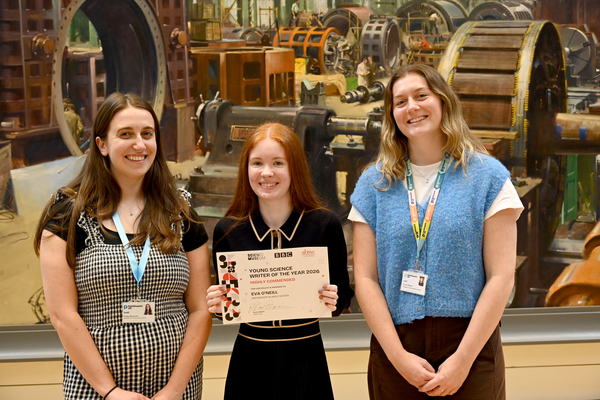

Eva O'Neill, 16, is a pupil at Archbishop Blanch in Liverpool. Her essay was highly commended in the Young Science Writer Award 2026 competition. She celebrated her achievement at the awards ceremony at London’s Science Museum on the 16th of September.
This essay aims to investigate how the gut microbiota is linked to the development of Parkinson’s disease, the potential utilisation of the gut-brain axis in treating and preventing Parkinson’s, as well as evaluate the widespread impact this could have on society.
Parkinson’s disease is a progressive neurological disorder. It causes nerve cells in part of the brain called the substantia nigra to become damaged and eventually die, decreasing dopamine production and disrupting the brain’s ability to function efficiently and carry out simple tasks. The neurotransmitter dopamine is produced in this area and is responsible for allowing smooth movement by transmitting signals. Studies have suggested that by the time of presentation, patients have lost 60–80% of their dopamine-secreting cells (National Institute of Neurological Disorders and Stroke, 2025).
Symptoms include muscle stiffness, tremors and impaired balance. Another key pathological feature is the abnormal aggregation of α-synuclein (α-syn), forming structures known as Lewy bodies. α-Synuclein is a protein found mainly in the presynaptic terminals of neurons in the brain. Braak’s hypothesis suggests Parkinson’s disease may originate in the gut, with pathological α-syn spreading to the brain and throughout the central nervous system (CNS). It proposes that α-syn first accumulates in the enteric nervous system (ENS), the part of the peripheral nervous system which controls the digestive system, and then spreads through the vagus nerve (Wang et al., 2025).
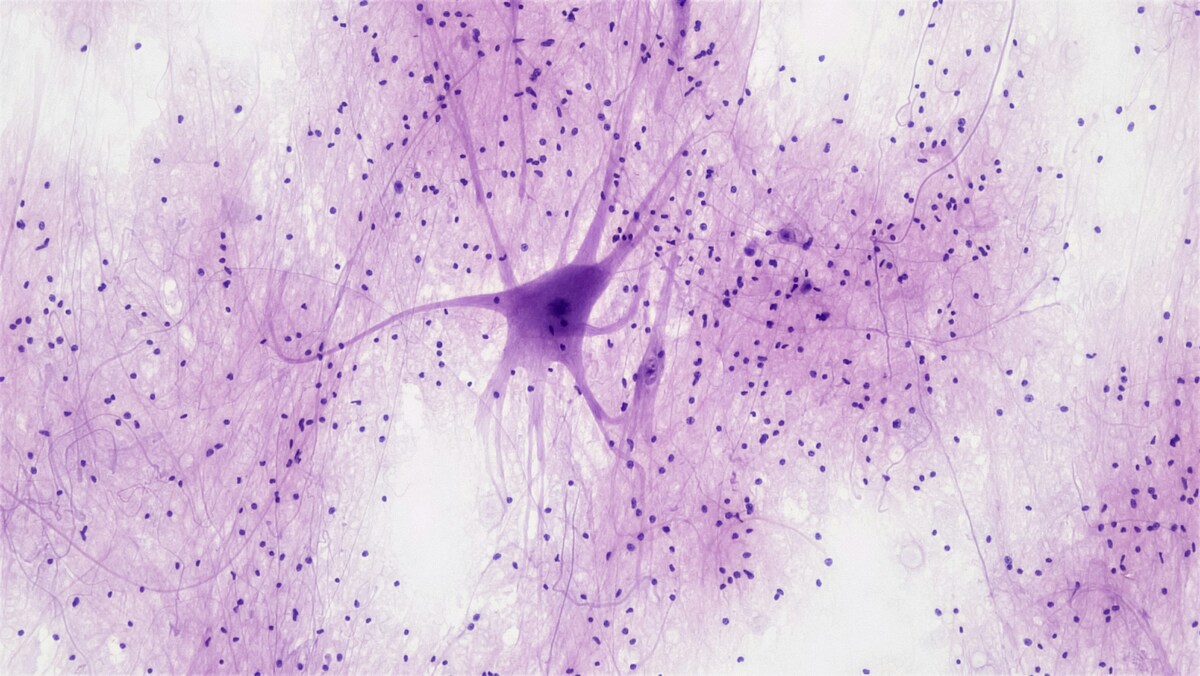
Photo caption: A motor neuron from the spinal cord, seen under a microscope. Photo: Bioscience Image Library by Fayette Reynolds / Unsplash.
The gut microbiota plays a significant part in digestion and immune defence, and can also influence neurological health. The gut microbiota refers to all the microorganisms living in the gut, most of which are located in the large intestine. Its functions include helping to defend against harmful pathogens and to digest fibre that cannot be digested by your body alone. The gut-brain axis refers to the two-way communication between your gastrointestinal (GI) tract and your CNS (Loh et al., 2024).
Changes in the gut and brain environment can affect your gut microbes. These microbes produce chemical transmitters that send signals, as well as other chemicals that spread through the bloodstream and can affect your brain. Dysbiosis, an imbalance of these microorganisms, can disturb these and other significant processes (Cleveland Clinic, 2024). Dysbiosis can also increase intestinal permeability, also known as ‘leaky gut’, resulting in endotoxins entering the bloodstream. Immune cells in the ENS are then activated, and the resulting chronic inflammation leads to further misfolded α-syn in the nervous system (Gushi and Derdas, 2025).
Furthermore, chemosensory cells known as enteroendocrine cells (EECs) are found throughout the epithelium of the intestine. Their surface is exposed to the intestinal lumen, giving them a direct pathway from the luminal contents to the nervous system. This is due to specialised basal processes called neuropods, which extend from the EECs to enteric neurons and afferent fibres of the vagus nerve, forming direct synaptic connections (Chandra et al., 2017).
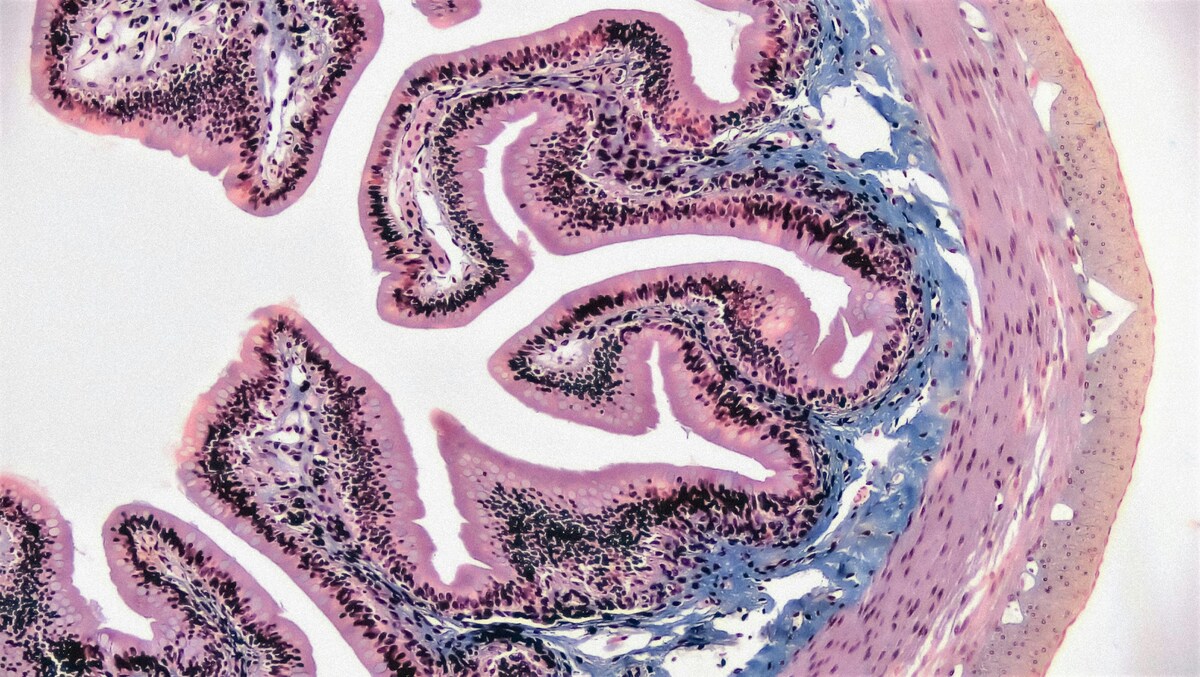
Photo caption: A cross-section of gut lining under the microscope, showing the finger-like villi. Photo: Bioscience Image Library by Fayette Reynolds / Unsplash.
This mechanism could enable misfolded α-syn to travel directly from the gut to the brain via the vagus nerve, where it accumulates and contributes to neurodegeneration. A study on patients showed those with a truncal vagotomy (the separation of the sections of the vagus nerve where the oesophagus meets the stomach) had an overall decreased risk of Parkinson’s disease compared to the general population group (hazard ratio = 0.85; post 20+ year follow-up, hazard ratio = 0.53). This suggests a link between truncal vagotomy and a decreased risk of developing Parkinson’s disease in the future, and could promote the development of treatments utilising the vagus nerve and gut-brain pathway, differing from conventional treatments that focus on managing symptoms in the brain once the disease has progressed (Svensson et al., 2015).
It can be argued that, by developing our knowledge of how the gut microbiota is involved in the development of Parkinson’s disease and how misfolded α-syn can travel to the brain, treatments could be revolutionised to be more efficient and cheaper whilst also focusing on the gut. Many drugs, such as levodopa and amantadine, have significant side effects like confusion, nausea and hallucinations. Developing new Parkinson’s disease pharmaceuticals utilising alternative treatment mechanisms, like focusing on the ENS rather than the brain, could potentially lessen these side effects. After I contacted Dr Shakya Bhattacharjee, a consultant neurologist specialising in movement disorders, he stated that,
…"gut microbiome modification can improve drug absorption and efficacy; however, gut microbiome modification can only stand a chance if the prodromal stages, which are difficult to detect, can be picked up early".
Furthermore, with around 166,000 people diagnosed with Parkinson’s disease in the UK (Parkinson’s UK, 2025), a more efficient and affordable treatment would make Parkinson’s disease more manageable, allowing more people a better quality of life. Overall, there is growing evidence supporting the link between the gut and the development of Parkinson’s disease. While studies support the gut-brain axis and there is high potential for future treatments from this, further research and tests are still necessary to confirm whether the link is causal and to develop reliable tests for early diagnosis.
Eva's original highly commended essay, has been lightly edited for grammar, clarity and flow. Read the adapted article on the Parkinson's UK website.