Survey reveals diversity gap in science journalism alongside widespread harassment
An online poll highlights inclusivity challenges and workplace and online harassment. By Andy Ridway, Senior Lecturer at UWE and ABSW Board member.
What are the challenges science journalists face and what barriers do they experience when trying to break into the industry? These are among the questions an online survey of science journalists sought to explore.
The survey was organised by the ABSW and the Science Communication Unit at the University of the West of England (UWE) to get a clearer picture of the experiences of science journalists. It suggests some worrying issues – both in terms of harassment and abuse faced by science journalists and a lack of diversity in the industry.
The questionnaire was circulated online in June and July, then again in October and November 2025 to attract as many participants as possible. It was aimed at science journalists whose work is predominantly published or broadcast in the UK – most participants (91%) were living in the UK, with others in Europe, Africa, North America and Central/South America. 65% of respondents (36 individuals) identified as a woman, 27% as a man and one as non-binary / genderqueer / agender / gender fluid.
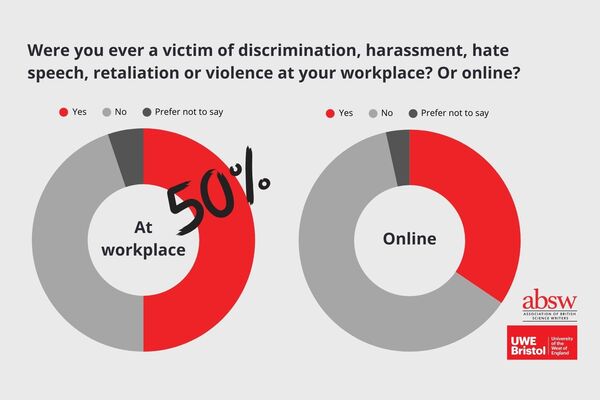
In terms of challenges, 50% of the respondents (29 individuals) said they had been the victim of workplace discrimination or harassment. This was most commonly related to participants’ gender identity, but cultural heritage and ancestry as well as age were also some of the more common sources of discrimination or harassment.
Online abuse or harassment also appears to be fairly common, with 34% of respondents (20 individuals) saying they had experienced it in connection with their science journalism or broadcasting work. COVID-19, vaccines and climate change were the subjects most frequently cited by respondents as sparking that abuse or harassment. For many, the abuse or harassment took place on social media – 17 of the 19 respondents who answered the question said it took place there. But our participants also told us that it appeared in comments on articles and videos, as well as via email.
One third of respondents (33%, 19 individuals) said there were some subjects they would avoid reporting on due to their concerns about online abuse or harassment. These subjects included human embryo research and science stories linked to politics and conflict. Only 25% respondents (14 individuals) said they had received training or support to help them cope with online abuse or harassment.
In our survey, 73% of respondents were white, 16% were of Asian descent or British Asian, and 5% said they were of African descent or Black British. If our respondents are a true reflection of those working in the field, it indicates a lack of diversity in who is writing about science.
The survey was organised by ABSW Community Manager, Vera Novais, ABSW Executive Board member and Senior Lecturer in Science Communication, Dr Andy Ridgway, and Professor in Science Communication, Dr Emma Weitkamp. The next steps will be for the ABSW Executive Board to discuss the support it can put in place for new and aspiring science journalists in relation to the issues identified.
UWE’s Science Communication Unit is the UK Hub of the newly formed European Competence Centre for Science Communication and will also use the survey to investigate ways to support science journalists more effectively, for example, through offering training, and will be working with the ABSW to develop further support resources.
The ABSW decided to run this survey together with UWE in part because of a lack of evidence to base its efforts to improve diversity upon, explained Andy Extance, ABSW chair. “Now that we have some clear indications about where the barriers in our profession are, we will seek ways to tackle them and try to measure the impact of what we do.”