Arnaud Robert named European Science Journalist of the Year 2026
The winners were revealed at the European Night at Leibniz University Hannover, an event of the European Conference of Science Journalism (ECSJ2026).

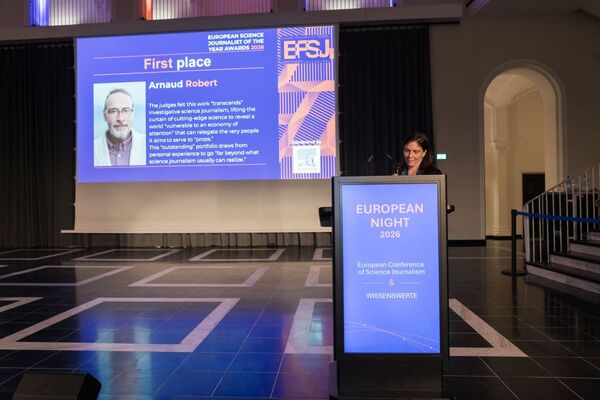
Picture: The winner, Arnaud Robert, could not attend the award ceremony in Hanover.
Article originally published on the EFSJ website.
The European Federation for Science Journalism (EFSJ) announced Arnaud Robert as the winner of the European Science Journalist of the Year Award 2026, with Linda Samplonius and Joseph (Jop) De Vrieze taking second place and Sigrid März and Martin Rücker taking third place. The winners were revealed at the European Night at Leibniz University Hannover on 14 October 2026.
The European Science Journalist of the Year Award was founded in 2014 by the Association of British Science Writers and has been run by the EFSJ since 2020.
The award, supported by Elsevier, recognises and promotes excellence and innovation in science journalism across Europe. It carries a prize of 2,000 euros for the winner and 1,000 euros for each of the two runners-up.
“Our award today recognises five exceptional journalists who have gone beyond mere reporting. Through their work, they remind us that curiosity, accuracy, and integrity remain the strongest antidotes to misinformation,” said Astrid Viciano, vice-president of EFSJ and board member of the WPK.
The awards were presented during the European Night, the opening evening of the European Conference of Science Journalism (ECSJ2026) held jointly with the German science journalists’ association WPK – Die Wissenschaftsjournalisten. This year’s conference, themed “Science Journalism for a World in Crisis”, ran on 14 and 15 October in Hannover alongside the WPK’s annual Wissenswerte conference, and brought together science journalists from across Europe and beyond.
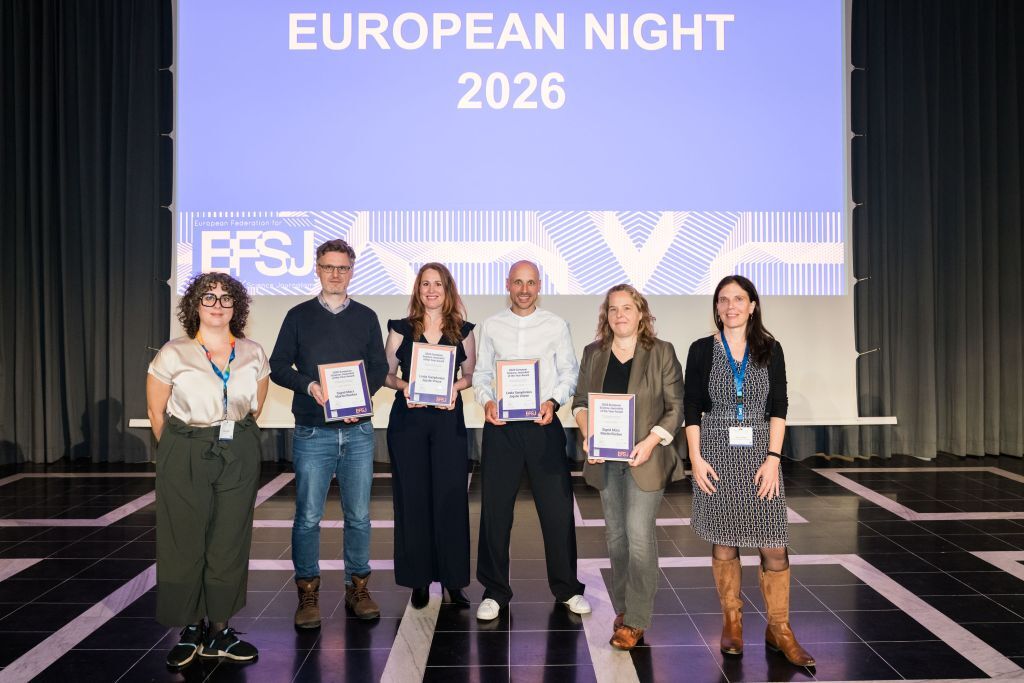
Picture: (From the left) Agnès Vernet (president of EFSJ), Martin Rücker, Linda Samplonius, Jop de Vrieze, Sigrid März, and Astrid Viciano (vice-president of EFSJ and secretary of WPK), at the award ceremony.
First place — Arnaud Robert — presented by the Swiss ASJS (Association suisse du journalisme scientifique). Robert is a Swiss journalist, filmmaker, and author whose work has appeared in National Geographic, Le Monde, Le Temps, and in the Swiss public broadcaster RTS, where he was a regular contributor up until 2026. Robert received a Swiss Press Award in 2020 for his investigation into the global “toilet revolution” and was named Swiss Journalist of the Year 2026 for Mon corps électrique, an RTS podcast in which he investigates, from inside the trial, how a groundbreaking clinical experiment attempts to repair his own tetraplegic body.
The judges of the European Science Journalist of the Year Award felt Robert’s “outstanding” portfolio “transcends” investigative science journalism, drawing from personal experience to go “far beyond what science journalism usually can realise.” They said the work lifted the curtain on cutting-edge science to reveal a world “vulnerable to an economy of attention” that can relegate the very people it aims to serve to “props.”
Robert could not be present on the night, and his award was delivered in absentia.
Discover Robert’s work (in French): here, here, and here.
Second place — Linda Samplonius and Joseph (Jop) de Vrieze — presented by the Dutch association VWN (Vereniging voor Wetenschapsjournalistiek en -communicatie Nederland). Jop De Vrieze is a biomedically trained independent science journalist specialising in stories where science and society intersect. Published in, among others, De Volkskrant, De Groene Amsterdammer, Science, New Scientist and Nature, de Vrieze is a two-time winner of the Dutch Journalist of the Year and winner of the AAAS Kavli Science Journalism Award 2016. He is the founder of the Amsterdam-based journalistic collective Bureau Wibaut and organiser of the biennial Golden Freelancer Award ceremony.
Linda Samplonius is a Dutch freelance journalist and author with over fifteen years of experience across print, digital, and audio media. Published in major Dutch news outlets such as RTL Nieuws and De Groene Amsterdammer, she has published two books, co-authored several others, and is currently working on a third. Her debut book was shortlisted for the Hebban|Crimezone debut prize.
Read this team’s work here (in Dutch): here and here.
Third place — Sigrid März and Martin Rücker — presented by the German association WPK. März and Rücker founded Investigativstation, a journalistic collective, in November 2024. It produces evidence-based, politically relevant and investigative journalism on health issues.
Rücker works as a freelance investigative journalist in Berlin. März is a freelance science journalist writing for various media outlets on medicine, health and biotechnology. At MedWatch, she headed the editorial team. Both have received numerous awards for their work.
Read this team’s work here (in German): here, here, and here.