Swindon pupil wins 2026 Young Science Writer Award
Adrian Dredge's essay on the hidden biases of artificial intelligence beat more than 200 entries from young writers across the UK.
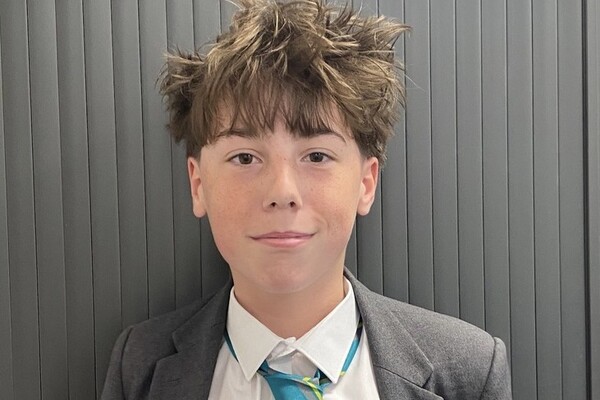
Adrian Dredge is the winner of the Young Science Writer Award 2026.
(Photo Credit: Miss Clarke, Chemistry Teacher, Great Western Academy)
Adrian Dredge, 15, a pupil at Great Western Academy in Swindon, has been named the winner of the 2026 Young Science Writer Award (YSWA). His essay The Digital Mapmaker: Navigating the Future with the Biases of the Past – a critique of algorithmic bias in artificial intelligence – beat over 200 entries from students from across the UK. As well as winning a cash prize of £1000, Adrian will see his essay published on the BBC website.
The Young Science Writer Award is an initiative of the Association of British Science Writers (ABSW) in partnership with the BBC and the Science Museum, with generous support from the O'Brien family, who founded the award. The award invites students aged 14 to 16 to write a piece of original science journalism for a general audience. Entry is open to UK state-funded non-selective schools, reflecting the award's commitment to identifying and nurturing science writing talent wherever it emerges.
This year's submissions came from more than fifty UK towns and cities. The geographical reach was wide, spanning Aberdeen, Edinburgh and Arbroath in Scotland; Cardiff, Newport and Wrexham in Wales; County Derry and other parts of Northern Ireland; and English regions from Cornwall and Devon through the Midlands, Yorkshire and the North West, to the South East and East Anglia. Manchester, London, Leicester and Stoke-on-Trent were among the most strongly represented communities.
Alex O'Brien, Chair of Judges and ABSW Chair, said:
“At a time when young people are bombarded with content vying for their attention – much of it misleading or simply false – and where more and more thinking risks being outsourced to algorithms, the ability to think critically, to question, and to communicate with clarity and purpose has never been more important. I was deeply impressed by the exceptionally high quality of submissions this year. They left me filled with great hope.
If we can inspire a generation to be excited about communicating facts and science stories in an engaging and meaningful way, then that is a truly hopeful future we can look forward to.”
Adrian’s winning essay builds an extended metaphor of a mapmaker locked in a windowless room, working only from fifty-year-old maps, to examine how AI systems trained on historical data can entrench the inequities of the past. Drawing on peer-reviewed research, the essay moves from predictive policing to healthcare algorithms, arguing that "a crime list is not a list of crimes; it is a list of where police have been told to stand."
Miss Clarke, chemistry teacher at Great Western Academy, said:
"We're really proud of Adrian. His essay shows exactly the kind of thoughtful, evidence-based approach we aim to build in all our students, and it's a great example of our Excellence value in action within our Achievement, Care and Excellence ethos. It's fantastic to see that recognised at this level – an important moment for him, for the department and for the wider school community. Adrian approached the topic with real focus and originality, and the final piece speaks for itself."
Ralph Sealey, a pupil at West Exe School in Exeter, and Poppy Marchant, a pupil at The Charter School North Dulwich in London, have been named joint runners-up and each receives £250. A further ten entrants have been recognised as Highly Commended, each receiving £100: Yavindi Singappuli Arachchilage, Saatchi Shah, Eva O'Neill, Evie Howard, James Reed, Tzvia Tabor, Blake Thomson, Kathryn Elloway, Albert Watson, and Madeleine Chesher. The full list of winning entrants and their schools is available on the ABSW website.
The winning entrants were selected from a competitive field by a panel of twenty-two judges drawn from across UK science journalism, broadcasting and research. The panel read every entry in full and worked through multiple rounds of shortlisting over several weeks. ABSW is grateful to all judges for the care and rigour they brought to the process.
The winners will be celebrated at the YSWA awards ceremony, hosted by Dr Roger Highfield OBE FMedSci, ABSW Honorary President, Science Director of the Science Museum Group and recipient of the Royal Society David Attenborough Award and Lecture 2025. The ceremony will feature an exciting programme bringing together young writers, their families, educators, judges, supporters and members of the science writing community to celebrate the achievements of this year’s winners.
ABSW gratefully acknowledges the supporters whose contributions enrich the experience of every YSWA winner: