As AI rises and broader continuing digital disruption of legacy media continues, the science writing and journalism profession faces issues too great for individuals to solve alone. That’s one of the key conclusions of the community assemblies held by the Association of British Science Writers in July 2026.

"The views our community shared of how we see our profession evolving are striking and invaluable," said Alex O’Brien, the organisation’s chair. "The ABSW has always sought to support those critiquing and communicating science. The assemblies now serve as a call to action for us to take our role to the next level and help us all collectively prepare for what’s coming."

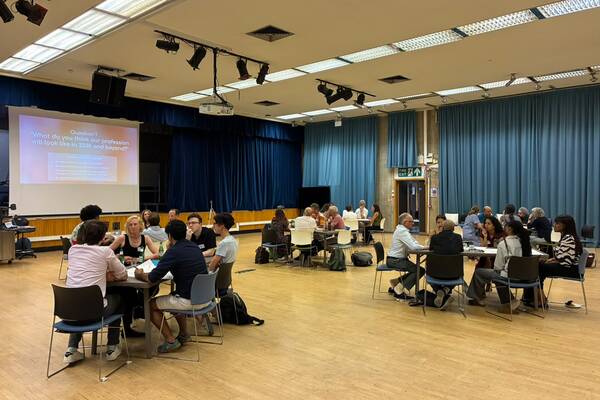
Across two two-hour meetings, 59 participants, including both ABSW members and people from outside the organisation, attended purely for the discussions. A further group made up of ABSW board members and externally recruited facilitators ran the event.

At the in-person assembly on July 2nd at Jeffery Hall, UCL, Wolfgang Blau, who held senior roles at The Guardian, Die Zeit and Condé Nast, set the scene. He laid out the way that generative AI is transforming journalism, and where expert communicators still add value.

The ensuing discussions revealed anxiety regarding AI and financial instability in the context of the loss of legacy media infrastructures. Participants highlighted a relentless wave of newsroom layoffs, pointing to recent culls and closures at prominent publications like Scientific American and Research Professional News.

Additionally, some parts of society are growing more sceptical toward scientific evidence. The fragmentation of traditional media brands therefore leaves journalists more vulnerable in an information ecosystem overrun by unverified content and AI-generated misinformation.

The groups therefore sought to establish how we adapt and differentiate ourselves. We have one advantage because trust is hard to come by today, meaning that relationships with people like us can help provide it.

Following Blau’s provocation, at the online assembly on July 9th, participants predicted that by 2030 science journalism will be more audience-centric. Content creators will move away from top-down dissemination toward meeting readers where they actually consume content. That’s because audiences of all ages are increasingly bypassing traditional platforms in favour of creators, social media influencers, and short-form video channels like TikTok and Instagram Reels.

To exist in a world of AI-generated content and social media algorithms, the primary role of the science journalist will shift. Rather than just reporting raw news, journalists will act as trusted translators to help audiences separate authentic scientific discovery from convincing but fictional narratives.

Across both events, participants identified five broad interconnected challenges:

  • the rapid automation of routine journalistic work through generative AI;
  • changing audience behaviour and the shift towards social-first and video-first media;
  • growing financial insecurity and the weakening of traditional media institutions;
  • increasing difficulty in establishing public trust;
  • and the need for a stronger, more collaborative professional community.

The discussions suggest several potential priorities for the ABSW. These include:

  • expanding training, mentoring and skills development particularly around areas needed for the new science journalism and communication landscape;
  • strengthening communication networks and building a more collaborative and supportive professional ecosystem;
  • increasing the visibility of journalists and helping audiences understand the value of their work; 
  • supporting more human-centred, creative and narrative-driven journalism;
  • experimentation with new forms of public engagement and reporting.

With AI being such a large challenge, this is where collective leadership could be particularly valuable. Participants suggested that the ABSW, in collaboration with other organisations, should develop a concise AI manifesto or clear standards to guide ethical and transparent use of AI in science journalism, potentially including a mark indicating the level or type of AI involvement in published work.

The in-person assembly most strongly supported lobbying for new funding models to sustain independent journalism. Specifically, it proposed a levy on social media platforms and generative AI companies such as OpenAI and Anthropic that have benefited from scraping journalistic content without compensation. The revenue generated from these levies would be ring-fenced and funnelled to support newsrooms providing quality content and holding authority to account.

Participants recognised that many of the profession's challenges are structural and cannot be solved by individual journalists alone. Taken together, the findings suggest a potentially important future role for the ABSW as a standard-setter, skills and support network, convenor of collaboration, advocate for sustainable funding, and champion of the distinctive human value of science journalism.

Andy Extance is a freelance science writer and ABSW Board member. Andy was one of the facilitators at the ABSW community assemblies.