Most of the UK public wants to see more science, Public Attitudes to Science survey finds
40% of those surveyed reported actively seeking scientific information via traditional media, the survey found. By Anoushka Sinha.
62% of the British public believe they do not see enough scientific information, according to the Public Attitudes to Science (PAS) 2025 survey, published in January 2026. This is the highest proportion seen since the surveys began 25 years ago.
The study is run by Ipsos and partners with the British Science Association, sponsored by UK Research and Innovation (UKRI). This is the first PAS survey to take place since the pandemic.
It uses a series of surveys and interviews to understand how the public views science, engineering, and technical innovation.
It was found that 80% of the public believes that scientists are valuable contributors to society, with 65% actively seeking scientific information in the last two weeks.
Notably, almost half of those surveyed checked the latest science-related information they came across while scrolling on social media.
In addition to this, 64% of the public agreed that the government should fund scientific research for long-term benefits.
So, what does this mean for us as science writers?
40% of those surveyed reported actively seeking scientific information via traditional media such as newspapers and news programmes, while 49% reported passively encountering the same.
With the public seeking more scientific information in their day-to-day lives, and half of everyone double-checking their science-related information which they passively come across, it is clear that there is a demand for what we do.
We must recognise that social media is the leading platform for the public to passively come across scientific information.
“In an evolving digital landscape, new media, encompassing social media platforms and YouTube, has become one of the main ways to access information on science,” the report emphasises.
The general attitude to science was positive, but trust seems to waver.
Only 40% of people agreed that the scientific information they come across is “generally true”. This is down from 50% in 2019.
More concerningly, 48% of people were uncertain that the science they come across is generally true. A follow-up question indicated that “most people’s rationale for trusting was not based on validating the information themselves, but was often based on having confidence in the processes, sources and institutions.”
While 87% of people trust scientists working for universities to follow the rules and regulations of their profession, only 48% trust scientists in private companies.
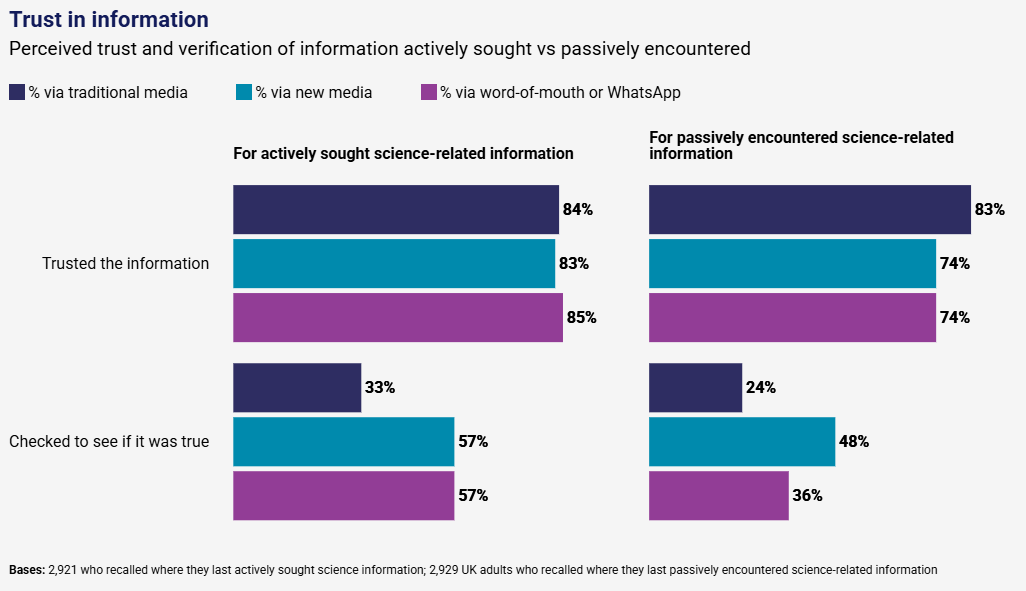
Image taken from the Public Attitudes to Science (PAS) Survey 2025 report, chapter 5.
The report described artificial intelligence (AI) as a ‘divisive’ topic, with one third of the population feeling that the benefits of AI outweigh the risks, and the same proportion believing the opposite.
49% of people feel well informed about AI, but the report points out that “making people feel more informed about AI or other controversial technologies may not, on its own, build public trust or allay concerns”.
Nevertheless, it is important to also recognise that some arguably controversial topics, like vaccines, were still relatively high; 66% of people felt well informed about vaccinations against disease, down from 71% in 2019. Despite the drop, 80% believe the benefits of vaccinations outweigh the risks.
So, is trust fluctuating? Yes.
Is demand for reliable science journalism on the rise? Also, yes.
As science journalists, it is important to take the findings of the PAS 2025 survey into account when informing the public about science. By understanding where the people’s confidence wavers, we can continue to bridge the gap between scientists and the public.
Additional resources:
* Science Barometer 2025, Germany (English version, February 2026)
* European citizens’ knowledge and attitudes towards science and technology - Eurobarometer 2025

Anoushka Sinha is the ABSW Student Representative. She is studying for an MSci in Physics with Astrophysics and Cosmology at King’s College London (KCL). She is the Science Editor at her university newspaper, Roar, and also works as an Astronomy Presenter at the Royal Observatory Greenwich.
Having covered ABSW events in the past, Anoushka is looking forward to creating more opportunities for students to gain hands-on experience in science writing through the ABSW.