Inspired and inspiring: The dyslexic astrophysicist hunting clouds of rubies
The ABSW held a networking and interview training event in Bristol. We are publishing the best article written by the attendees. By Marian Scaife


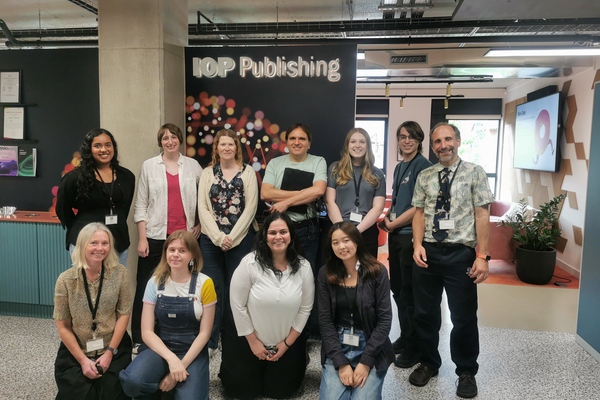
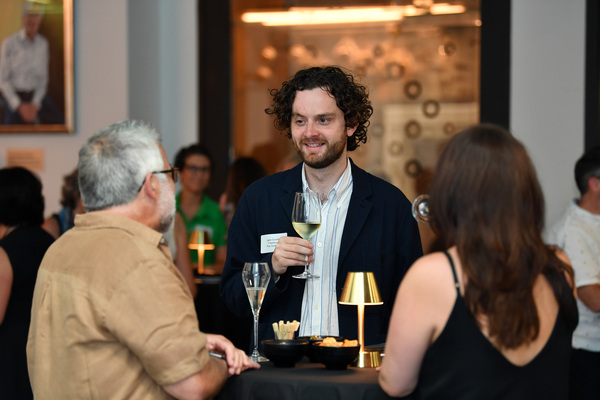
On 4 September 2026, the ABSW held a networking and interview training event at the offices of IOP Publishing in Bristol. We are publishing the best article written by the attendees. Thanks to Andy Extance, Anoushka Sinha, Matin Durrani, Margaret Harris, and the entire Physics World team for their help. We would also like to thank the interviewees Hannah Wakeford and Ion Wood-Thanan.
Though Hannah Wakeford compares the sizes of planets in our solar system to different fruits, she represents Earth with an imaginary pea she places on the table. Earth gets to be a vegetable because it’s unique.
“And then Jupiter is the size of an orange,” says Hannah. “Some of the planets I’m looking at are watermelon-sized.”
For Hannah, an Associate Professor of Astrophysics at the University of Bristol, the planetary fruit basket analogy is a key tool for conveying the awe of exoplanets, planets outside our solar system. When she asks a general audience questions, “I want everybody to know the answer,” Hannah says. “That requires a little bit more of a breakdown, a little bit of a different approach.”
She knows this, thanks to her own experience growing up with dyslexia. And now, she wants to inspire others, just like she was inspired to become an astrophysicist, discovering amazing alien planets with the $10 billion (£7.5 billion) James Webb Space Telescope (JWST).
Growing up in a family where university ‘wasn’t a thing’, Hannah’s dyslexia drew her to non-fiction books. “Fact books always had bigger fonts and clearer statements,” she says. “I found them much easier to digest than fiction.”
Though she never imagined it when she was young, Hannah now leads Bristol’s Exoplanet Timeseries Characterisation (ExoTiC) research team. They study exoplanet atmospheres and their impact on their planet’s climate and environment.
To do that, Hannah and her team look at planets as they pass in front of their stars. Some of the starlight shines through the atmosphere around the edge of the planet. Every atom and molecule in that atmosphere interacts with the light differently, creating a signature.
“I want to understand if I take an atmosphere to its extreme, what happens?” Hannah says. Extreme exoplanets help test the limits of what humans know about physics and chemistry. For example, her team has studied a planet with an atmosphere of 1,700 ºC and winds over 5,000 mph containing tiny nano-sized glass crystals. “You would be baked and shredded basically, not a holiday destination.”
The JWST collects the signatures revealing such dramatic atmospheres. Operational since 2022, this telescope, with its gold-plated mirrors, has been revolutionary to astrophysics. It enables scientists to see in the infrared part of the electromagnetic spectrum. “In astrophysics we all love the electromagnetic spectrum,” Hannah says, because different parts allow scientists to study different kinds of substances.
Hannah’s entire career has been building up to understanding what we can learn from JWST, she says. Before it launched, her research predicted what it would be able to measure. That work included studying a Saturn-sized planet, WASP-39b, and led to a ‘wow’ moment for Hannah.
During the early release phase of data from JWST, WASP-39b was measured for 10 hours of observations; it took a couple of days for the satellites to line up and transmit the data back to Earth. Hannah remembers vividly how beautifully the data fitted her predictions.
“The precision of the data, the accuracy of it, was so high that it just blew me away and made me tear up,” she says. “It was just an amazing culmination of the work we had done… being able to see that this telescope is really going to change what we can do, and what the future could offer.”
In her quest to inspire others, Hannah currently co-hosts Exocast: The Exoplanet podcast with astrobiologist Andrew Rushby and fellow astrophysicist Hugh Osborn. She has also co-authored the updated third edition of the book ‘Bang!! The complete history of the Universe’ with Brian May and Chris Lintott. It explains the chronology of the universe from the Big Bang, while avoiding maths.
Meanwhile, in her research, Hannah is seeking a very hot exoplanet with unusual clouds, made of rubies. Or more precisely, corundum, a crystallised form of aluminium oxide, the basis of both rubies and sapphires on Earth. “They are the first things that should form at high temperatures, and we’ll be able to measure them,” says Hannah. “We’re not there yet. But my fingers are crossed. I really want to find these ruby clouds.”
For more of Hannah you can follow her on BlueSky @StellarPlanet or head to https://stellarplanet.org/.
Photo at the top: Hannah Wakeford, Associate Professor of Astrophysics at the University of Bristol

Marian Scaife is a freelance science journalist with a background in ecology and wildlife conservation who specialises in the life sciences. She loves finding stories that challenge preconceived ideas or lift the lid on the misunderstood and bringing those to a wider audience. Marian is fortunate to have three degrees – wildlife conservation, biological recording and magazine journalism and is currently enrolled in the ABSW mentor scheme. Marian is based in Derby and says her happy place is on a tennis court.