Elise Cutts and Siddhant Pusdekar selected for the third round of the FRONTIERS Residency program
The European project pays independent journalists to immerse themselves in research institutions for up to five months.

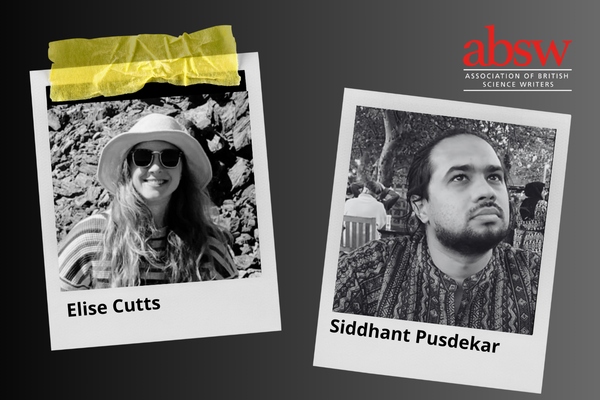
ABSW members Elise Cutts and Siddhant Pusdekar are among the eight early-career journalists selected (from 31 applicants) for the third round of FRONTIERS Residencies. Cutts will be hosted by the Complexity Science Hub (CSH) in Vienna, Austria, and Pusdekar by the Interdisciplinary Centre of Marine and Environmental Research (CIIMAR) in Porto, Portugal.
Until December 2024, Siddhant Pusdekar was a researcher. Now he will be immersed in a research institute again, but looking at it from a very different angle and in a different capacity. “I see part of my role as a journalist to help build trust between scientists, the media and the public. And as a former researcher, I feel well placed to do that”, he says. “As an early-career science journalist, fellowships like this are very valuable for building a beat and a reputation in the field.”
For early careers and freelancers alike, the fellowship allows them to take some risks. “I have breathing room to take on bigger projects and try things that could fail, as well as learn new tools”, Cutts says. “My main goal for the fellowship is to do two things that are new to me: write a book proposal and learn to produce podcasts and simple videos.”
Cutts writes about the intersection of physics with other fields, and complexity science takes a physics approach to life, society, and other interesting systems. That’s why the Complexity Science Hub in Vienna was a natural fit for her. Pusdekar, on the other hand, hopes to acquire in-depth knowledge about ocean microbiomes and, maybe, join one of the institute´s field campaigns.
For three to five months, FRONTIERS selected journalists will work alongside research teams across Europe, supported by a monthly grant of up to €4,000. During this period, journalists experience an immersive period in an institution engaged in ‘frontier research’, meaning those who focus on scientific questions on the edge of knowledge, and research which is often difficult to explain and hard to justify.
The Complexity Science Hub “is very much a computers-and-blackboards research institute, not a field station or lab, so my day-to-day is a lot of reading and chatting and coffee in the baroque palace the CSH calls home”, Cutts explains. Being based in Austria herself, Cutts sees this as an opportunity to stay in touch with researchers to follow their work over time.
Journalists are expected to be working on their own reporting ideas at institutions of their choice, but they don't need to publish anything. But, of course, they hope to do so. Pusdekar hopes to “get some compelling stories and visuals” and pitch them to international outlets. He will also be posting regularly on his social media and blog.
“My planned outputs are a book proposal and a podcast mini-series”, Cutts says. “I'm also using the time to write regularly on my newsletter Reviewer, too.” Of course, she hopes to find tons of materials to pitch magazines, “but I'm trying not to overload myself by taking on freelance work during the fellowship because it's such a rare chance to focus on things that don't pay off immediately”.
FRONTIERS is the science journalism initiative funded by the European Research Council (ERC) to design a residency program for journalists wishing to experience an immersive period in a research institution. It will run from 2023 to 2027 and engage up to 40 science journalists. The project will also propose a set of ethics principles, best practices and guidelines for journalistic fellowships, and develop a long-term sustainability model.
The fourth round of applications is now open and will close on 25 May 2026, at 17:00 CEST. The call is open to professionals at all career levels, from early-career (up to 5 years of experience), to mid-career (6 to 9 years of experience), and established (10+ years of experience) journalists.