Competition Essentials
Everything you need to know, in one place—key details, guidance, and practical steps to help you guide your pupils to take part with confidence.

Who can enter: Pupils aged 14–16 in eligible UK schools (state-funded, non-selective). If you are in any doubt about whether your institution is eligible, please contact the Programme Director at [email protected]
Essay length: We ask pupils to aim for 800 words, with a 10% flexibility either side, meaning entries must be no shorter than 720 words and no longer than 880 words (excluding references). This range is deliberate: writing under 720 words rarely gives enough space to introduce the topic clearly, develop a line of reasoning, and support key points with evidence. Writing over 880 words tends to weaken the piece through repetition or unnecessary detail, and it often suggests the pupil has not had the opportunity to edit down to the strongest ideas. In short, the word limit is designed to reward strong planning, clear structure, and concise scientific communication—qualities that are central to excellent science writing.
File format: PDF only. This is essential for our judging process. If an essay is submitted in any other format, we will ask the pupil to resubmit it as a PDF. To avoid confusion and duplicate entries, please encourage pupils to submit one final PDF version only, ensuring it is in the correct format before uploading.
Deadline: The Young Science Writer Award opens for entries on Wednesday 7th January 2026 at 09:00 GMT. We will close the competition on Thursday 19th March 2026 at 23:59 GMT.
Judging focus: clarity, accuracy, evidence-use, originality, structure, and engagement.
Core expectation: Pupils should be able to show where their key facts come from, in a way that a reader can check. That means using sources responsibly and citing them clearly.
To mark the Young Science Writer Award’s five-year anniversary, we are introducing five entry categories, which we are calling the Five Frontiers. When you submit your essay, you will choose one Frontier. These categories are designed to help you orient your topic within a broad area of modern science and technology, spot the key scientific ideas your reader will need, and shape your piece around a clear central question.
Use your chosen Frontier as a starting point for brainstorming, then narrow your essay to one specific question, discovery, debate, or real-world application. Your topic can sit anywhere within science, engineering, medicine, or technology, as long as your writing is evidence-based and clearly explained for a general reader.
Remember, your essay must include at least one quotation from a relevant source. This could be an expert, a researcher, a clinician, an engineer, or someone with real-world experience of the topic. Including a quote helps you go beyond repeating what you have read online. It shows you have investigated your topic, weighed up different viewpoints, and thought critically about what the evidence and opinions suggest. Your job is then to explain what you learned from that quotation and how it shaped the conclusion you reached. Please note, that you should only email people if you have included your parent/guardian or teacher in the email. This is to ensure safety. Please check with your teacher or parent/guardian if you are unsure of the best way to contact someone you would like to speak to.
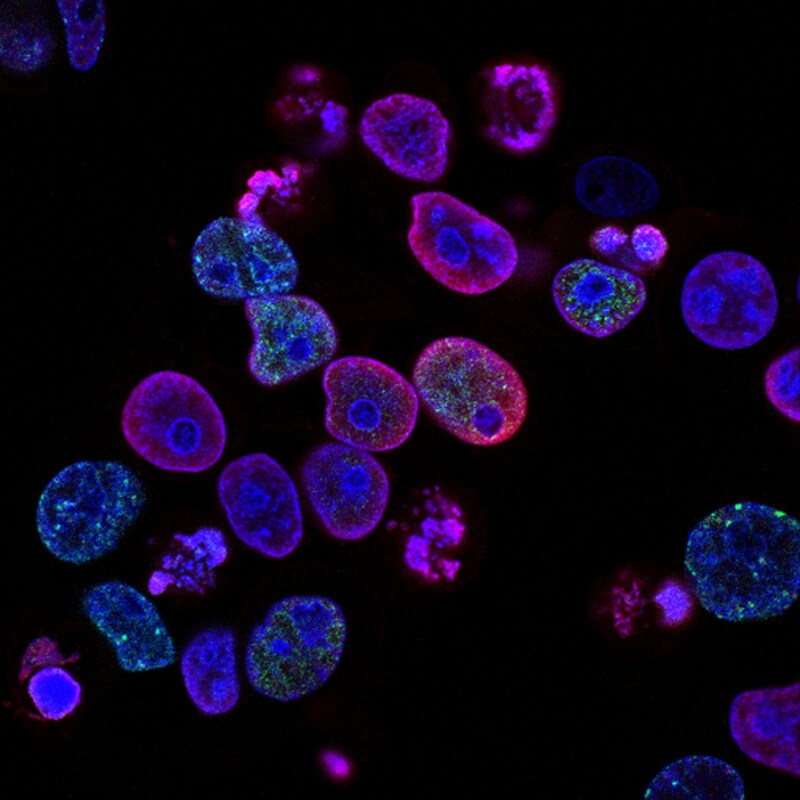
🧬 Frontier 1. Life Reimagined
Bioengineering | Genetics | Neuroscience | Medicine
Expanded scope ideas: immunology, synthetic biology, ageing science, reproductive science, regenerative medicine, microbiomes, prosthetics and assistive tech, public health, disability science, mental health science, personalised medicine, drug discovery, bioethics.
Possible essay-driving questions (examples):
Image Credit: Human colorectal cancer cells treated with a topoisomerase inhibitor and an inhibitor of the protein kinase ATR (ataxia telangiectasia and Rad3 related), a drug combination under study as a cancer therapy. Cell nuclei are stained blue; the chromosomal protein histone gamma-H2AX marks DNA damage in red and foci of DNA replication in green. Created by Yves Pommier, Rozenn Josse, 2014

🤖 Frontier 2. The Digital Brain
AI | Computing | Robotics | Data Ethics
Expanded scope ideas: machine learning, cybersecurity, human–computer interaction, social media and information ecosystems, surveillance and privacy, algorithmic bias and fairness, explainability and accountability, autonomous systems, digital health, AR/VR, education technology, labour and automation, governance and regulation, energy use of computing.
Possible essay-driving questions (examples):
Image Credit: Growtika on Unsplash
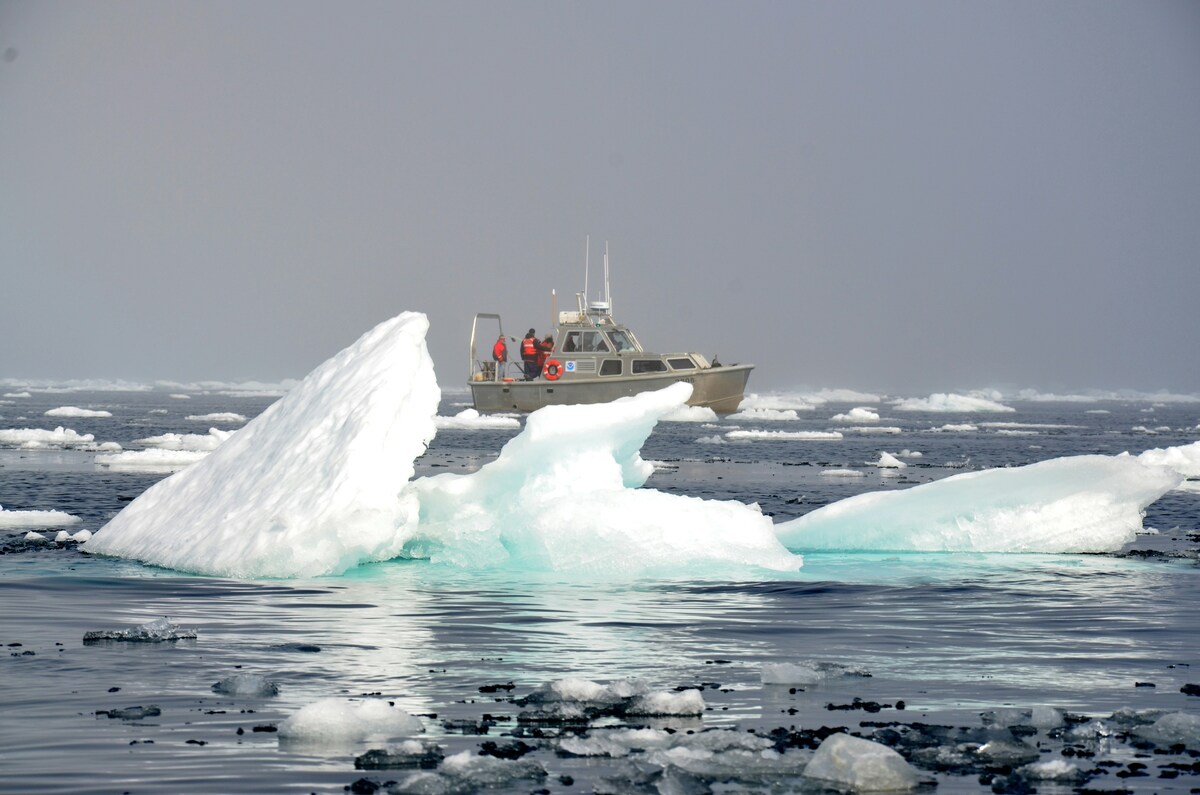
🌍 Frontier 3. Planetary Futures
Climate | Energy | Sustainability | Ecology
Expanded scope ideas: biodiversity, food systems, agriculture, water security, pollution and toxicology, environmental justice, climate adaptation, extreme weather resilience, circular economy, geoengineering, conservation technology, sustainable cities, transport systems.
Possible essay-driving questions (examples):
Image Credit: Survey launch from NOAA Ship FAIRWEATHER in the pack ice about 40 miles west of Point Barrow.

🧫 Frontier 4. Invisible Worlds
Chemistry | Microbiology | Quantum Physics | Materials Science
Expanded scope ideas: nanotechnology, catalysis, atmospheric chemistry, radiation, structural biology, pharmacology, semiconductors, batteries, superconductors, emergent properties, measurement science, microscopy and imaging, scientific uncertainty.
Possible essay-driving questions (examples):
Image Credit: Yellow Fever Colorized transmission electron micrograph of Vero E6 Cells in culture infected with Yellow Fever Virus particles found within distended regions of the endoplasmic reticulum. Image captured and color-enhanced at the NIAID Integrated Research Facility (IRF) in Fort Detrick, Maryland. Credit: NIAID https://www.flickr.com/photos/niaid/51738868585/

🌌 Frontier 5. Cosmic Perspectives
Space | Physics | Astronomy | Big Questions
Expanded scope ideas: planetary science, astrobiology, cosmology, satellites and Earth observation, space debris, radiation biology, fundamental physics, mathematics, time, origins, philosophy of science, ethics of exploration, commercial space.
Possible essay-driving questions (examples):
Images Credit: Abstract Art Found in the Orion Nebula Caption Close inspection of the 2006 Hubble Space Telescope color mosaic of the Orion Nebula (M42) reveals numerous treasures that reside within the nearby, intense star- forming region.


