How to cover science at risk – lessons from Ukraine
War reshapes science and challenges global science journalism. Tips on how to report on wartime research responsibly. By Olesia Pavlyshyn

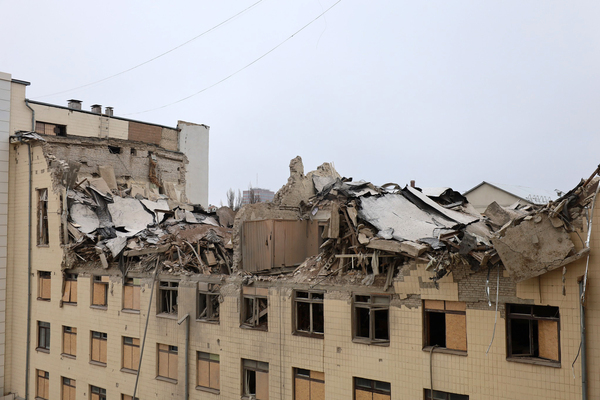
Kharkiv National University of Urban Economy, in Ukraine, after a Russian rocket strike on 5 February 2023. (Credits: Main Directorate of the State Emergency Service in Kharkiv Oblast / Wikimedia Commons)
When defending against a war of aggression, the main priority must be to save human lives and prevent military occupation. So naturally, science coverage gets pushed to the background. Yet science, among other things, is what makes it possible to recover territory and protect those lives.
Perhaps this is why, according to a study by UNESCO and the Junior Academy of Sciences of Ukraine, Russia has destroyed or damaged 1,443 buildings of 177 Ukrainian scientific institutions since 2022. Restoring these buildings will cost more than $1.21 billion. At the same time, Russia has killed at least 167 Ukrainian scientists.
War prevents research, destroys infrastructure, and displaces teams. The state of Ukrainian science during Russia’s full-scale invasion is a painful but unique case that presents international journalists with new thematic, ethical, and political challenges.
Still, covering science is an important way not only to draw global attention to local problems but to share lessons about preserving scientific progress. But how can we do this sensitively and ethically, while still uncovering scientific truth?
War shifts scientific priorities. Ecologists cannot ignore the destruction of the Kakhovka Dam, Russia’s occupation of Europe’s largest nature reserve, Askania-Nova, or soil degradation. Medical professionals have begun producing medications and supplies to meet the needs of the front (such as the hemostatic agent Krovospas). They are also gaining battlefield experience, which is changing medical protocols worldwide. Physicists and engineers have shifted to improving drones. Museum workers are learning on the fly how to protect valuable artefacts.
This is a cutting-edge expertise that Ukrainian science can share with the world and use to build international scientific collaborations.
War is inescapable. It is essential not to overlook this context, even when writing about physics, biology, or ecology. No matter how many people write about so-called “war fatigue,” avoiding it fundamentally distorts reality.
This is especially true for projects that have a direct impact on other countries, such as those in the Black Sea region. In 2020, Ukrainian scientists carried out the world’s first eDNA screening of the entire Black Sea. Today, this project cannot be continued because of Russia’s full-scale invasion of Ukraine: the coastline is mined, and active hostilities are taking place in the sea itself.
The Ukrainian–Japanese nuclear collaboration between scientists studying the consequences of nuclear disasters at the Fukushima and Chornobyl nuclear power plants is also under threat. Today, researchers do not have access to the Exclusion Zone and cannot continue their studies, while Japanese specialists have only limited access to Ukraine.
Similarly, the destruction of the Kakhovka Reservoir has multiple dimensions – both industrial and ecological. From an industrial and human perspective, it is a catastrophe: hundreds of thousands of people and dozens of industrial facilities were left without access to water, and during the destruction itself, thousands of people were killed or lost their homes, including scientists. At the same time, from an ecological perspective, this region has a chance for recovery, as human activity has ceased in the area and the ecosystem is beginning to regenerate. The impact of the war is felt at every level.
Archaeologists cannot speak about excavations without mentioning the mining of steppes and forests. Astronomers will struggle to avoid referencing the telescope in the Kharkiv region that Russia destroyed and is being restored. Context does not politicise science – it explains its boundaries.
Western experts often comment on Ukraine instead of Ukrainian ones. For example, a 2023 study showed that only 29.5% of medical research publications on the Russo-Ukrainian war included Ukrainian co-authors. And when journalists do approach Ukrainian scientists, they tend to seek out those living abroad rather than in Ukraine, as noted in a study by Kseniia Oksamytna. Moreover, she notes, when they do speak with scientists in Ukraine, reporters are often “looking for emotional responses from academics with personal connection to the war rather than to hear their informed analysis.” Ukrainian researchers are stigmatised as “biased and untrustworthy.”
But how can we discuss the realities of Ukraine without Ukrainian professionals? What other scientific fields are discussed “from the outside”? If we refuse to treat Ukrainian researchers as equal interlocutors, we undermine the accuracy, ethics, and quality of our reporting.
We can approach scientists in Ukraine in different ways. For example, there is the Science at Risk project database, where you can find verified scientists based on your topic, taking into account the languages a researcher speaks. You can also identify relevant experts through the website of the National Academy of Sciences of Ukraine or through specific research institutes. In some cases, this will require knowledge of Ukrainian, so you may need a translator. If you are unable to find a scientist on your own, the best option is to contact Ukrainian researchers working abroad. The Ukrainian scientific community is relatively small, so they are often able to recommend colleagues in Ukraine, even if the topic does not fall within their own immediate area of expertise. Local Ukrainian science journalists may also be able to help you find an expert on a specific topic.
Ukrainian scientists indeed work under extremely difficult conditions, but their identity is not defined solely by this. It is crucial to avoid “exoticising” war and to remember that Ukrainian researchers still work systematically and professionally. They are still integral to the global scientific community.
A survey of 2,559 Ukrainian scientists revealed that despite infrastructure destruction, evacuation, and power outages, most have found ways to continue their research. These are not only stories about victims, but also about people who develop novel research strategies and partnerships. Moreover, in 2023, the Horizon Europe Office began operating in Ukraine, promoting international scientific collaboration between Ukrainian and European researchers.
From a communicational perspective, it means focusing not exclusively on questions related to the war and active hostilities. This helps avoid portraying the topic solely through an emotional lens.
Ask solution-oriented questions such as: “What changed in your methodology? What worked? What failed? What can others learn from this?” Quote Ukrainian experts on their technical decisions, not only on their personal suffering. Balance the human impact of the war with recognition of their professional competence.
Similarly, rather than highlighting Ukrainian blackouts alone, explain how researchers reorganised lab schedules, shared generators, or shifted to computational modelling.
Try to avoid labels such as “Scientists working under bombs” and “Research conducted in basements” and instead focus on the topic of the research itself. Quote them not only on Ukraine, but on broader disciplinary debates. Instead of asking Ukrainian energy researchers only about blackouts, ask them to comment on centralised vs decentralised grid resilience – a debate relevant to climate adaptation worldwide.
When reporting on the direct effects of the war on scientists, avoid vague language (“was damaged,” “affected by fighting”). It erases responsibility and scientific meaning. So we should specify the mechanism, not just the outcome (“Russian missile strike”, “artillery shelling,” “occupation and looting”).
Avoid passive constructions where causality is known. For instance, “The laboratory was destroyed by a Russian missile strike in March 2023,” not “The laboratory was damaged during the conflict.”
In regions affected by war, the main priority is preserving life and safety – both your own and that of your interviewees and institutions. Careless behaviour can cause irreparable damage to infrastructure and result in human losses. Even local journalists can overlook details that later allow the targeting of critical facilities. For instance, several days after a TV segment revealed production details at the Kyiv Armoured Plant, the facility was hit by a missile.
Ukrainian science can be directly or indirectly linked to military production and medical assistance while the country defends itself against a war of aggression, which itself is a crime. When visiting research institutions, we must balance our duty to present the piece accurately while respecting the risks to our human subjects. We must not mistake safety precautions for censorship.
This is especially true for areas near the frontline. For example, Russian glide bombs destroyed the Oles Honchar Library and the Local History Museum in Kherson. These institutions don’t even have an indirect link to the military.
This is why we should not disclose floor plans, lab layouts, production volumes, exact locations of facilities, and, in some cases, the names of staff. As an alternative, use general descriptions (“a facility in central Ukraine”), ask institutions to approve technical descriptions for safety, or use archival or pre-war photos, clearly labelled as such.
Territories may be mined or unsafe due to destruction or the proximity of military facilities. In such cases, staff can help. You can, for instance, provide them with equipment so they can take photos themselves. Often, they already have images documenting damage. This is what happened with the relocated Institute of Irrigated Agriculture. Access to its main facilities in the Kherson region is closed, but staff managed to capture unique footage of the damage.
Build trust with staff and help them feel safe speaking with you. The easiest way is to find a bilingual fixer who has already worked with the institution or to reach out to local journalists. Even those in Kyiv do not always grasp the security situation on the ground or the psychological state of local communities. So we might turn to Ukraine’s public broadcaster, Suspilne, whose regional reporters understand the context of threatened towns and villages. It can also help if we cannot reach the place of our interest or visit Ukraine on our own.
Ukrainian scientific institutions, like those in many war-affected countries, often lack dedicated communication departments and tend to be highly hierarchical. You may be unable to speak with employees without a director or senior staff present. Nevertheless, enthusiasts are eager to share their work almost everywhere, which deserves to be highlighted.
The key to building rapport is empathy and understanding. Let them know you are “on their side,” so to speak, and you want to understand their context. Learn about the colonial-imperial history that preceded Russia’s invasion of Ukraine. Learn a few basic phrases in Ukrainian. It would also be useful to learn the Ukrainian transliteration of the local names, which were previously inherited through the Russian language (e.g., Kyiv instead of Kiev, Chornobyl instead of Chernobyl). This would show that we understand the context and help us build trust.
Scientific institutions are aware that Ukraine needs international support and collaboration. So it’s worth explaining the benefit of your coverage: the more people abroad learn about their work and their needs, the easier it becomes to find colleagues who can contribute to future research.
Be particularly thoughtful with institutions that were under occupation. Often, these are stories of destruction and pain, but also of resistance and resilience. In the Kherson and Kharkiv regions, you can find experiences that will be valuable for institutions worldwide. For example, researchers from Kherson State University successfully evacuated one of the largest herbaria in Ukraine. The Kharkiv UTR-2 radio telescope is being restored after all its equipment was looted by Russian troops.
The situation is constantly changing, so maintain contact after your visit, and even after the story is published. For instance, just a few months after journalists visited Sumy State University, it was targeted in an airstrike.
Respect for researchers, being cautious of working with trauma, and broadening our understanding of context are crucial components for science journalism during wartime. Science continues even under the most difficult circumstances. Journalists can help the world see it as it truly is: ongoing, despite everything.
About Science at Risk:
Science at Risk is a digital platform and community of Ukrainian scientists affected by Russia’s war, documenting how Ukrainian researchers and institutions navigate wartime challenges and develop unique expertise in crisis response.
About the author:
Olesia Pavlyshyn is a science journalist and the Editor-in-Chief of the Ukrainian popular-science media outlet “Kunsht”.