‘Craft still matters’: Siri Carpenter on learning from the best science stories
Mun Keat Looi, ABSW member, interviews Siri Carpenter, co-founder of The Open Notebook, about the "Storygrams" format and the future of journalism.
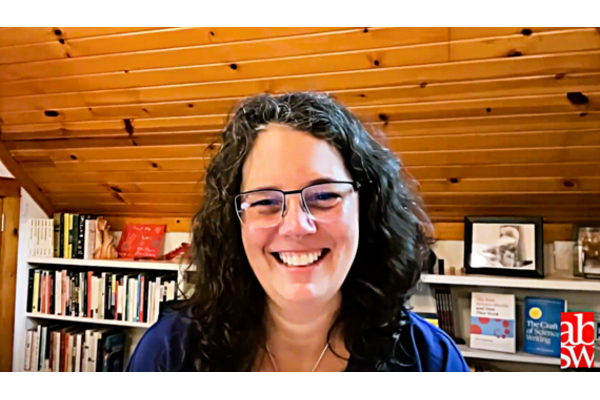
Siri Carpenter is an award-winning science journalist and editor. She is the co-founder, executive director, and editor-in-chief of The Open Notebook. Her latest edited book, ‘The Best Science Stories and How They Work’, published in July, builds on The Open Notebook’s ‘Storygrams’ – annotated articles from a fellow journalist that offer commentary and analysis of the work – with a new set of never-before-seen annotations of science feature articles.
Siri spoke to the ABSW about how this format came about, and what science journalism looks like in an age of AI and populism.
How did Storygrams arise?
I really love to take stories apart and understand what makes them tick – it’s part of how I learned to be a writer and a journalist. I didn’t go to journalism school.
I was adjunct teaching at the University of Wisconsin, teaching a science writing class. What I found out was that my students were just not really prepared to [critique stories]. They had not had that experience of reading a story for the purpose of understanding what makes it a good story, or for the purpose of learning as a writer.
So I created a sort of a cheat sheet about how to do a close read, and we started having much deeper conversations about the stories. Coming out of that experience, I had this idea that I would really like to be able to take that over to The Open Notebook and dissect some stories.
Do people become more open to constructive criticism?
We’re all human beings, and it’s hard to take criticism in general. The spirit of these annotated stories is very much starting from the principle of: we like this story, we think this is a great story, and we’re going to dig into what makes it so good.
That isn’t to say that these stories are perfect; no story is perfect… The purpose of this is to celebrate and investigate what it is that makes this story so good.
Most of these stories might have one or two points of gentle critique. I think that it’s really helpful, because it shows that this is a human process, and we’re not holding up these stories as the Platonic ideal of perfect stories. We’re just saying these are really good; there’s a lot that you can learn from them.
What were you looking for when you were deciding which stories to include in the book?
I started by just making lists of stories that I liked and reached out to others in the science writing community to nominate some of their favourite stories within the last 10 years or so.
Of course, I was looking for a balance of themes and publications and topics and writers and tone of the stories. After that initial pass, I probably had over 200 stories, and we had room for about 10 or 11. It was a really painful process of narrowing it down and thinking about what would make a good collection, stories that I felt would fit well together, and that collectively would bring forth a lot of different qualities of the best science stories.
How would you advise early career journalists or journalism students to use a book like this?
The ideal way to read it is: read through a story in its entirety and then go back and read it with the annotations, and make some of your own annotations as well. There’s no harm in writing in a book.
Mark certain specific structural pieces, like: here’s where the lead is, here’s how long it is, here’s the nutgraph, here’s a kicker, here’s an example of a transition, and different types of transitions.
Another thing is think about it at the level of language and go through and highlight, for example, all of the active verbs. Or all of the adverbs.
Another type of exercise that we use a lot when we’re teaching editing workshops is ‘reverse outlining’: taking a story and writing an outline of the story as it exists. When you strip out some of the details, and you’re looking at it in that bullet point outline way, you can get a better understanding of structurally what’s happening in that story.
If it’s your own story, then this reverse outlining process can help you fix structural issues within a story. If you’re an editor who’s editing someone else’s story, it can help you yourself understand: what is the problem here? Why am I having so much difficulty with this story?
Does thinking about our craft and paying closer attention feel more important now?
100%. It would be incredibly naive to say that these are great times for journalism or for science. These are incredibly challenging times, but there has never been more need for audiences, for our readers, to be informed about the evidence around the topics that they care about the most.
Our tagline at The Open Notebook is, ‘Every story is a science story’. It’s crucial to civic life that people are able to understand the evidence that underlies the issues that they care about, and that they have to make decisions about in their day-to-day lives, or in their voting.
I really believe that craft still matters, and that doing it well still matters, and that we have to continue to try to empower and inspire the next generation of journalists. What is the alternative – to just give up on the whole enterprise? That would be a bad alternative.
What should science journalism look to protect, especially in the AI era?
There are so many things that we humans can do that I believe AI can’t. I’m not a total AI doomer, but I would not say that I’m an AI booster. I think there’s plenty of important and good uses for AI [but] many of the uses of generative AI in journalism I find to be really troubling.
So far, our AI policy at The Open Notebook has basically been: don’t do it. Don’t pitch us AI-written pitches. Don’t send in drafts that have been written or edited by AI.
There are many, many things that writers and editors do that cannot be matched by a robot. As an industry, we should recognise and reward those human talents and incentivise people to not take shortcuts that are ultimately going to be harmful to journalism and to their audiences.
‘The Best Science Stories and How They Work’, edited by Siri Carpenter, is published by University of Chicago Press and available to buy now.
Mun Keat Looi is the International Features Editor at The BMJ, lectures on journalism at Imperial College London, and is a former ABSW Board member.