ABSW Awards 2026: Closed to entry
Eleven categories were open to entry throughout January 2026

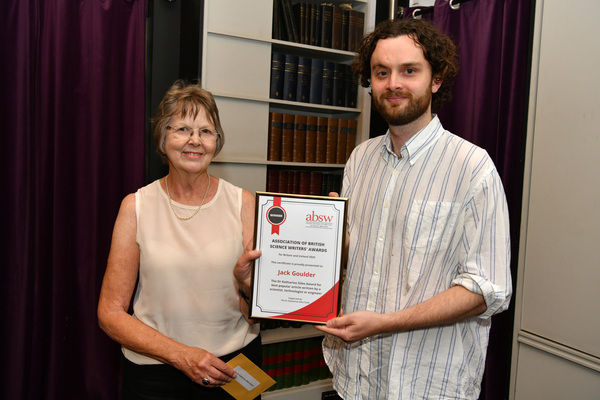
Pictured with Dorrie Giles, mother of the late Dr Katharine Giles after whom the award is named
Winning an ABSW Award means a huge amount. I'm a really new writer, and I have to thank my editor Claire Longrigg at The Guardian, who is amazing. She guided me through so many drafts. This prize feels like it belongs as much to The Guardian long read team as to me. It means a lot to bring these stories to life—the people I got to know and work with. Hopefully, it helps demystify some of that experience.
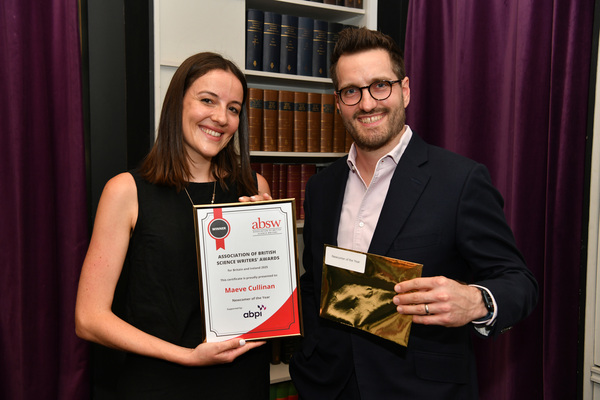
Pictured with Jack Neill-Hall of the Association of the British Pharmaceutical Industry, the Award sponsor
It feels like such a privilege to win an ABSW Award. It's great to be in such amazing company, with all the people who've previously won this award and all the other winners. It feels very special and it's very exciting.
In 2026 there were 11 Awards, for self-entry
All formats
Print/Online only
Format specific awards
In 2026, the ABSW is offering one Award by nomination only. The Lifetime Achievement Award - our most prestigious award - is based on nominations from ABSW members. Find out more and nominate.

09:00 January 1, 2026 (GMT) - Awards open to entry
23:59 January 31, 2026 (GMT) - Awards close to entry
Week of June 1, 2026 - finalists announced
18:30 Wednesday June 24, 2026 - winners announced at the annual awards ceremony at The Royal Society, London - all finalists and ABSW members invited
With thanks to our 2026 ABSW Award partners: The Association of the British Pharmaceutical Industry (ABPI), The Dr Katharine Giles Fund, The Royal Society and our media partner AlphaGalileo
Would you like to support excellence in science journalism by supporting an ABSW award in 2026? Find out more.
ABSW members and members of the Irish Science & Technology Journalists' Association (ISTJA) pay nothing to enter the awards as it is a benefit of membership. Non-members are required to pay a fee of £55 per category entered. There is no fee to nominate an individual for the Lifetime Achievement Award.
Why not join the ABSW now to enter for free and receive all our membership benefits?

*New for 2026* All written/printed work MUST be entered by PDF, URLs are no longer acceptable as the judges have encountered too many access issues with URL entries (see below for acceptable file formats for all entries and guidance on creating a PDF from your URL)
Work entered must have been published or broadcast on or between 01 January 2025 and 31 December 2025.
Work entered must be accessible to the general public.
You can only enter once in each category (NB: for teams they must be ‘substantially different’ in order to enter more than once in a category).
You can enter more than one category (NB: for non-members you pay a fee for each category entered).
You cannot enter the same piece of work in different categories, apart from those entering categories where multiple pieces of work are allowed (Newcomer) as you can then enter these individual pieces in other categories.
Submissions must be substantially about science, technology, engineering or mathematics (STEM) or their impacts, rather than non-science pieces about health, medicine or the environment.
The Awards are for works published within the UK or Ireland and are intended for British and Irish-based journalists and writers, or those working for audiences in these two countries.
The Awards are for individual journalists and writers, or teams of up to four people, rather than for the organisation, institution, employer or publisher. All team members must be named in team submissions.
The judges reserve the right to reallocate an entry to a category different from the one in which it has been entered, as well as the right to withhold an award in any category. The decision of the judges in all matters will be final. The judges will not provide individual advice or feedback to entrants.
ABSW members cannot (i) submit to any category on behalf of non-member colleagues nor (ii) nominate colleagues – all entries must be submitted directly.
Acceptable file formats
Print/Online: Entry by PDF ONLY. URLs will not be accepted. Entries made by URL will be disqualified. To create a PDF from your URL go to the URL in your browser, use keyboard shortcut 'Ctrl+P' (Command + P for Mac) to open print options and for 'Destination' select 'Save as PDF'
Video: URL or widely accessible file format.
Audio: URL or widely accessible file format.
URL submissions must be fully accessible to judges. Judges will not take out subscriptions, fill in registration forms or take any other steps to access your work. If the work is not immediately accessible from the URL provided the entry will be disqualified.
Files should be uploaded through the entry form - instructions are available on the entry form for larger files that the form system may not be accept.
NB: Please also read category-specific guidance under the description of each category.
Feature of the Year: general audience
Print/online only
For a feature published in print or online in any title that is primarily consumed by, and aimed at, a general, lay audience, whether broadsheet or tabloid in style. Examples include The Daily Mail, The Economist, New Scientist, Financial Times, Unearthed, BBC News. The feature may be part of a series or a standalone piece, but only one item in the series can be entered into the awards.
You must submit by PDF
Feature of the Year: specialist audience
Print/online only
For a feature published in print or online in any title that targets specific, specialist audiences such as scientists, health professionals, chemists or engineers, whether trade press or other specialist publication. Examples include Nature, Carbon Brief, Chemistry World, Physics World, Computer Weekly. The feature may be part of a series or a standalone piece, but only one item in the series can be entered into the awards.
You must submit by PDF
News Item of the Year
Any format
For a single news item published or broadcast in any medium. Examples include breaking news stories and first in-depth reports. The judges look for evidence that the story is new to a relevant audience, as well as excellent writing and original reporting.
Written work must be submitted by PDF
News Analysis of the Year
Any format
For stories that provide an insightful explanation of the science behind the headlines and valuable new context and background to the news. The judges are looking for excellence and creativity in journalism.
Written work must be submitted by PDF
Steve Connor Award for Investigative Journalism - in memory of Science Journalist Steve Connor
Any format
For an in-depth investigation into a topic of scientific interest, leading to a conclusion. Submissions should detail any lengthy or complicated evidence gathering, and any difficulties faced. The award can be for a single item or a series of items, although only one item in the series can be entered for judging.
Written work must be submitted by PDF
Research Policy or Funding Story of the Year
Any format
For stories that tackle policy and funding agendas related to science and technology research.
Written work must be submitted by PDF
Opinion Piece/Editorial of the Year
Individual submissions, print/online only
For written work that expresses an opinion or aims to change opinion. This includes opinion columns, editorials and blogs.
You must submit by PDF
The Royal Society Audio Award - supported by The Royal Society
Audio only, eg: radio or podcast
For an audio programme or podcast where STEM is the primary issue covered. The award can be for a single programme or series, although only one item in the series can be entered.
Video of the year
Visual only
For video journalism produced for online and where STEM is the primary issue covered. The award aims to recognise content which is produced specifically for an online audience (rather than work intended for broadcast on a TV channel). The judges will be looking for great story telling and science communication. The award can be for a single video or series, although only one item in the series can be entered.
The Dr Katharine Giles Award for best new academic voice - supported by the Dr Katharine Giles Fund
Any format
This award is intended to encourage more academic scientists, technologists and engineers to communicate with the public through the media and is therefore for those relatively new to producing content for a media outlet rather than academics with an established media career (ie: regular column, podcast or TV programme for example).
Written work must be submitted as PDF
Newcomer of the Year
Individual submissions, any format, three supporting pieces of work
For science writers who published their first ‘professional’ piece within the past three years (01 January 2023 – 31 December 2025). Entrants should be currently working in journalism, whether freelance or staff, full-time or part-time. The judges are looking for evidence of initiative and career progression, as well as quality journalism and depth of reporting.
Written work must be submitted by PDF


